
Subject Strengths Analyzer
Enter Your Mock Test Scores
Your Analysis
Enter your mock test scores to see where you need improvement.
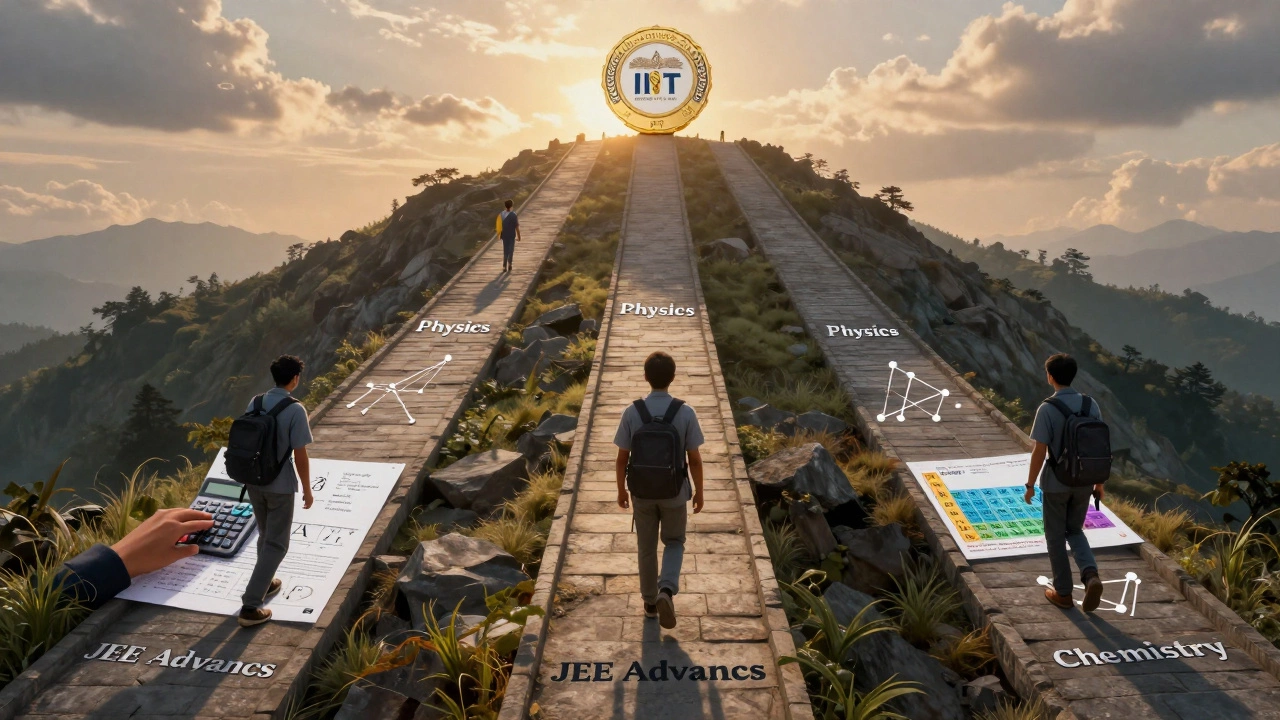
There’s no single "best" subject in IIT JEE preparation - but there is a best strategy. Many students think physics is the hardest, chemistry is the easiest, or math is the king. The truth? It’s not about which subject is best - it’s about which one fits your brain, your pace, and your goals.
Why the "best subject" question is misleading
Students often ask, "Should I focus more on physics?" or "Is chemistry enough to get me into IIT?" That’s the wrong question. JEE doesn’t reward specialists. It rewards balanced performers. The exam is designed so that you can’t clear it by excelling in just one subject. If you’re great at math but weak in chemistry, you’ll lose marks on easy, high-weightage questions. If you skip physics entirely, you’ll miss out on 30-35% of the total marks.Top rankers don’t have a favorite subject. They have a routine. They know their weak spots. They revisit them. They don’t avoid what’s hard - they attack it daily.
What each subject really brings to the table
Mathematics: The scoring engine
Mathematics is the most predictable subject in JEE. If you practice the right patterns, you can solve 80% of the paper with confidence. Topics like coordinate geometry, calculus, and algebra make up nearly 60% of the math section. These are formula-heavy, but once you internalize the standard approaches - like substitution in integration or section formula in 2D geometry - you can solve them fast.Here’s the catch: math rewards speed and accuracy. One calculation error, and you lose the entire 4 marks. That’s why top performers do 2-3 timed mock sections every week. They don’t just solve problems - they time themselves. A student who solves 25 math questions in 45 minutes with 90% accuracy will outscore someone who solves 30 with 60% accuracy.
Physics: The thinking subject
Physics is where most students struggle - not because it’s hard, but because it’s abstract. You can’t memorize your way out of a mechanics problem. You need to visualize forces, understand energy flow, and apply Newton’s laws in real-time. The most common mistake? Trying to memorize derivations instead of understanding how they work.For example, the derivation of simple harmonic motion from Hooke’s law isn’t just for theory. It shows you how restoring force relates to displacement - a pattern that appears in spring-block systems, pendulums, and even electrical circuits. If you understand that link, you can solve new problems you’ve never seen before.
Focus on: Newton’s laws, rotational motion, electrostatics, and modern physics. These topics appear every year. NCERT physics is enough for JEE Main - but for Advanced, you need deeper problem-solving. Books like HC Verma and I.E. Irodov aren’t optional for serious aspirants.
Chemistry: The memory game with logic
Chemistry is split into three parts: physical, organic, and inorganic. Each behaves differently.- Physical chemistry is like math with words. Concepts like equilibrium, thermodynamics, and electrochemistry follow clear rules. If you understand the formulas and units, you can solve almost every numerical.
- Organic chemistry is reaction-based. Memorizing mechanisms (SN1, SN2, E1, E2) is useless unless you understand electron movement. Learn how nucleophiles attack, how carbocations stabilize, and why certain groups are electron-donating or withdrawing. Once you get the logic, you can predict products - even for unfamiliar compounds.
- Inorganic chemistry is pure memory. Periodic trends, coordination compounds, and qualitative analysis need repetition. But here’s the trick: don’t memorize randomly. Group elements by blocks (s, p, d, f) and learn their patterns. For example, transition metals always form colored compounds and complex ions. That’s a pattern you can use to guess answers.
Many students skip inorganic chemistry because it feels "boring." But it’s the highest-scoring section in JEE Main. 10-12 questions come directly from NCERT tables. Get those right, and you’re already ahead of 70% of the crowd.
What the toppers do differently
Rank holders don’t pick one subject. They build a system.- They allocate time based on weightage, not preference. Physics gets 35%, math 35%, chemistry 30% - not because they love math, but because that’s how the exam is structured.
- They solve past papers from 2015 to 2025. Not just once. Three times. Each time, they analyze: Which topics repeated? Which questions were tricky? Where did they lose marks?
- They keep a mistake journal. Not just "I got this wrong." But: "I confused torque with work in rotational motion because I didn’t visualize the axis." That level of detail turns errors into learning.
One 2025 JEE Advanced topper shared: "I spent more time fixing my chemistry mistakes than learning new topics. I had 17 wrong answers in inorganic in my first mock. By the final exam, I got 16 out of 17 right. That’s +64 marks. That’s a 500-rank jump."
What you should do right now
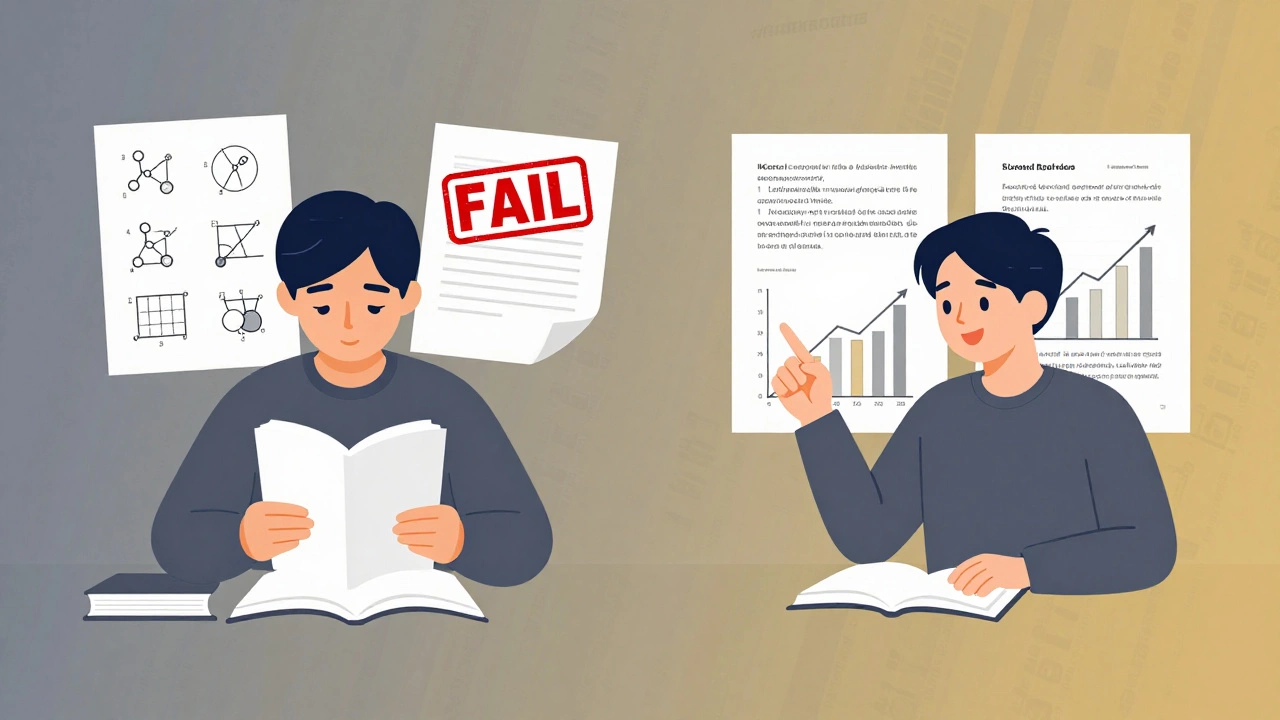
Stop asking which subject is best. Start asking: "Which subject am I neglecting?"- Take your last three mock tests. Count how many questions you got wrong in each subject.
- Find the subject where you lost the most marks - even if it’s your favorite.
- Block 45 minutes daily for just that subject. No math. No physics. Just chemistry - or physics - or math.
- Repeat for 10 days. Then retest.
You’ll be surprised. The subject you thought was "easy" might be holding you back. The one you avoid? That’s your goldmine.
Final truth: There’s no "best" - only "balanced"
IITs don’t want geniuses in one subject. They want engineers who can think across domains. A good mechanical engineer needs physics to design, math to calculate, and chemistry to understand materials. JEE tests that exact balance.If you’re spending 70% of your time on math because you think it’s "the best," you’re setting yourself up for failure. The exam doesn’t care what you like. It only cares what you know - across all three subjects.
So stop chasing the myth of the "best subject." Start building the habit of the "complete student." Solve every topic. Every day. Even the boring ones. That’s how the top 1000 get there.
Is physics the most important subject for JEE Advanced?
Physics is high-weightage and challenging, but it’s not "most important" by itself. JEE Advanced is designed to test depth across all three subjects. In 2024, the average score gap between top performers and others was smallest in chemistry - meaning many lost ranks not because of physics, but because of weak inorganic or organic questions. Focus on balanced preparation.
Can I skip chemistry and still get into IIT?
No. Chemistry makes up 30% of the JEE paper. Even if you score full marks in math and physics (140/140), you’d still need at least 75/100 in chemistry to clear the cutoff. Many students fail because they underestimate chemistry - especially inorganic. NCERT-based questions are easy marks. Skipping them is like leaving free points on the table.
Which subject has the highest scoring potential in JEE Main?
Chemistry has the highest scoring potential in JEE Main. Around 10-12 questions come directly from NCERT text, especially in inorganic chemistry. These are fact-based, low-difficulty, and highly predictable. If you memorize periodic trends, hybridization, and common compounds, you can score 80+ out of 100 in chemistry with minimal practice. Math and physics require more problem-solving, but chemistry gives quick wins.
Should I focus more on math if I’m good at it?
If you’re strong in math, use that strength to build momentum - but don’t neglect the others. Math can boost your rank, but JEE is a three-subject race. Many students who scored 90+ in math still missed IIT cutoffs because they scored below 40 in chemistry. Use your math advantage to cover gaps elsewhere - not to ignore them.
Is it true that JEE Advanced is physics-heavy?
JEE Advanced has slightly more physics questions than JEE Main, but the weightage is still balanced. In 2023, physics was 34%, math 33%, and chemistry 33%. The difficulty lies in how questions are framed - not in quantity. Physics problems require multi-step reasoning, but chemistry and math have their own traps. The myth of "physics-heavy" comes from its complexity, not its share.