
Professional Exam Difficulty Comparator
Compare the CFA, Bar Exam, USMLE Step 3, and CPA based on pass rates, study hours, and primary challenges.
Analysis Results
Imagine sitting for eight hours straight. No breaks. No phone. Just you and a stack of questions that could determine your entire career trajectory. Now imagine failing that test despite studying for months, only to be told you have to start over again next year. This isn't a horror movie plot; it is the reality for thousands of professionals chasing the most prestigious credentials in finance, law, medicine, and accounting.
We often hear people claim their specific certification is the "hardest" in the world. The Certified Public Accountant (CPA) candidate argues about tax law complexity. The lawyer complains about the sheer volume of case precedents. The doctor points to the life-or-death stakes of the USMLE. But which one actually holds the title? To answer this, we need to look beyond ego and examine three concrete metrics: pass rates, study time required, and the cognitive load of the material.
The Gold Standard of Finance: The CFA Program
When discussing professional exams, the Chartered Financial Analyst (CFA) designation usually tops the list for finance professionals. It is not just one exam; it is a gauntlet consisting of three levels, each requiring a separate six-hour sitting. The CFA Institute, based in Charlottesville, Virginia, maintains strict standards because the charter is globally recognized as the benchmark for investment analysis.
The difficulty here lies in the breadth and depth. Level I tests your knowledge of quantitative methods, economics, and financial reporting. Level II dives into asset valuation, requiring you to calculate intrinsic values of stocks and bonds under pressure. Level III is where most candidates break down. It shifts from calculation to portfolio management and wealth planning. You are no longer just analyzing numbers; you are constructing strategies for high-net-worth clients.
Pass rates tell a grim story. Historically, the global pass rate for Level I hovers around 40%. For Level II, it drops to roughly 45%, but the real killer is Level III, which often sees pass rates between 30% and 35%. Candidates typically spend 300 to 400 hours preparing for each level. That means nearly 1,000 hours of dedicated study over two to four years while working full-time jobs. The attrition rate is staggering-only about 10-15% of those who register for Level I eventually earn the charter.
The Legal Gauntlet: The Uniform Bar Examination
If finance is about predicting markets, law is about memorizing and applying centuries of precedent. The Uniform Bar Examination (UBE), administered in many U.S. states, is widely considered one of the toughest academic hurdles in the legal profession. Unlike the CFA, which is modular, the Bar is a marathon event. In some jurisdictions like New York and California, candidates face up to 20 hours of testing over two or three days.
The structure itself induces anxiety. The Multistate Professional Responsibility Exam (MPRE) tests ethics, but the main event is the Multistate Bar Exam (MBE). This 200-question multiple-choice section covers seven subjects: contracts, torts, constitutional law, criminal law, evidence, real property, and civil procedure. You must master all seven simultaneously. Then comes the essay portion, where you must write coherent legal arguments under extreme time pressure.
California offers a stark example of difficulty. Its bar exam is notoriously difficult, with pass rates frequently dipping below 20% for first-time takers. Why? Because the state uses its own unique exam rather than the UBE, and the grading curve is incredibly steep. A candidate might score 140 out of 200 on the MBE and still fail if their essay scores are mediocre. The mental toll is significant. Many bar prep students report severe burnout, sleep deprivation, and anxiety disorders during the preparation period, which typically lasts two to three months of full-time study after law school graduation.
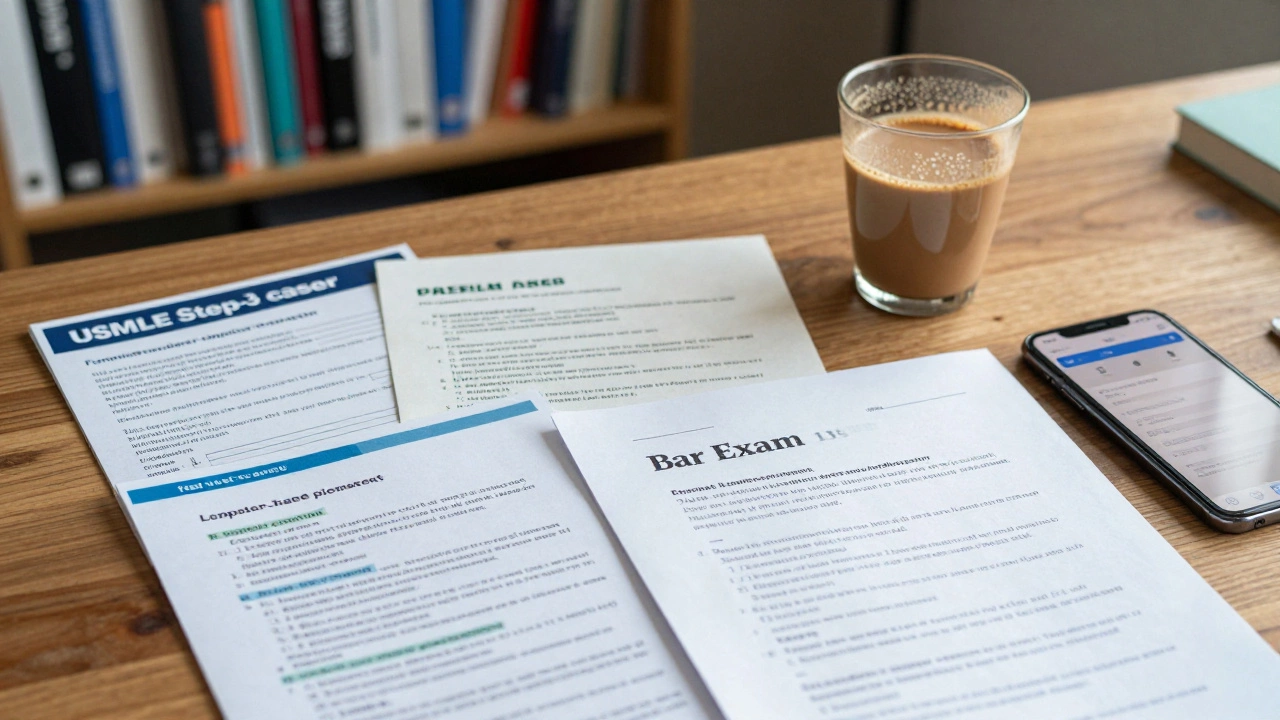
The Gatekeeper of Medicine: USMLE Step 3
In medicine, the United States Medical Licensing Examination (USMLE) serves as the primary gatekeeper. While Step 1 and Step 2 cover basic sciences and clinical knowledge respectively, Step 3 is often cited as the hardest because of its context. You are taking this exam while already working as an intern or resident, managing patients, pulling 80-hour weeks, and dealing with life-and-death decisions daily.
The format has evolved. Previously, it was a two-day exam with heavy emphasis on written cases. Now, it incorporates computer-based cases (CBCs) where you manage virtual patients over simulated time. You order labs, interpret results, and adjust treatments in real-time. This dynamic component adds a layer of stress that static multiple-choice questions cannot replicate. You are being tested on decision-making speed and accuracy under fatigue.
While the overall pass rate for Step 3 is higher than the Bar or CFA (often exceeding 90% for U.S. medical school graduates), the difficulty spikes for International Medical Graduates (IMGs), whose pass rates can drop to 60-70%. Furthermore, the stakes are existential. Failing any step of the USMLE can jeopardize your residency match, effectively halting your career before it begins. The emotional weight of knowing that a wrong answer could theoretically lead to patient harm in the real world makes the psychological barrier immense.
The Accounting Beast: The CPA Exam
For accountants, the CPA exam is the rite of passage. Administered by the American Institute of CPAs (AICPA), it consists of four sections: Auditing and Attestation (AUD), Business Environment and Concepts (BEC), Financial Accounting and Reporting (FAR), and Regulation (REG). Recently, the AICPA updated the exam structure, removing BEC and introducing Discipline sections, but the core difficulty remains unchanged.
The FAR section is widely regarded as the most difficult. It requires mastery of complex accounting standards, including lease accounting, revenue recognition, and consolidation of financial statements. The volume of material is comparable to a semester-long university course compressed into a few months of study. Candidates often spend 350-400 hours preparing for each section.
The pass rates vary by section. AUD and REG often see pass rates around 50%, while FAR struggles to reach 45-50%. The cumulative nature of the exam means you must pass all four sections within an 18-month window (in most states). If you fail one section, you do not lose your progress on others, but the clock keeps ticking. The pressure to maintain momentum while working at a busy-season accounting firm adds another layer of exhaustion. Many candidates take two or more attempts to clear all sections, leading to significant financial and emotional strain.
Comparing the Titans: A Data-Driven Look
To objectively compare these exams, we need to look at key metrics. Below is a comparison table highlighting the critical differences in structure, duration, and success rates.
| Exam | Total Study Hours | Average Pass Rate | Format Complexity | Primary Challenge |
|---|---|---|---|---|
| CFA Level III | 300-400 hrs/level | ~35% | Portfolio Construction | Breadth & Depth |
| Bar Exam (CA/NY) | 600-900 hrs total | 20-50% | Essays + MBE | Volume & Speed |
| USMLE Step 3 | 200-300 hrs | ~90% (US Grads) | Computer Cases | Context & Fatigue |
| CPA Exam (FAR) | 350-400 hrs/section | ~45% | Task-Based Simulations | Technical Detail |
Looking at the data, the CFA stands out for its low pass rates and high cumulative study time. The Bar Exam wins on sheer volume of content and the subjective nature of essay grading. The USMLE is harder due to the professional context, not necessarily the academic content. The CPA is a grind of technical precision.
Why "Hardest" Is Subjective
Declaring a single "hardest" exam is misleading because difficulty is personal. A quantitative thinker will find the CFA’s statistical models manageable but may struggle with the Bar’s nuanced legal reasoning. A verbal learner might ace the Bar essays but drown in the CPA’s complex accounting equations. Your background, learning style, and current life circumstances dictate what feels impossible.
Consider the concept of "cognitive load." The CFA requires you to hold multiple variables in your head simultaneously-interest rates, inflation, currency fluctuations, and geopolitical risks. The Bar requires you to recall specific statutes and apply them to hypothetical fact patterns instantly. The USMLE demands pattern recognition in diagnostic scenarios. Each type of thinking is exhausting in different ways.

Strategies for Conquering Any Professional Exam
Regardless of which exam you choose, the principles of success remain consistent. Here are actionable steps to maximize your chances:
- Create a Realistic Study Plan: Do not underestimate the time required. Block out specific hours in your calendar and treat them as non-negotiable appointments. Use tools like Notion or Excel to track progress.
- Active Recall Over Passive Reading: Highlighting textbooks is ineffective. Use flashcards (Anki is popular among med students) and practice questions. Test yourself constantly. If you can explain a concept without looking at notes, you know it.
- Simulate Exam Conditions: Take full-length practice exams under timed conditions. This builds stamina and reduces anxiety on test day. For the Bar, write essays by hand if required. For the CFA, use the calculator extensively.
- Prioritize Health: Sleep, nutrition, and exercise are not luxuries; they are performance enhancers. Cognitive function declines sharply when you are sleep-deprived. Aim for 7-8 hours of sleep per night during prep.
- Join a Community: Study groups provide accountability and moral support. Sharing insights with peers can reveal blind spots in your understanding. Online forums like Reddit’s r/CFA or r/BarExam are valuable resources.
Final Thoughts on Professional Rigor
The "hardest" exam is ultimately the one that aligns with your career goals and challenges your weakest areas. Whether you are aiming for the CFA charter, passing the Bar, clearing the USMLE, or earning your CPA license, remember that these exams are designed to filter for competence, resilience, and dedication. They are not meant to be easy. They are meant to ensure that those who hold these titles are truly qualified to protect public interest, manage assets, or save lives.
Choose your path wisely, prepare strategically, and trust the process. The struggle is temporary, but the credential-and the expertise behind it-is permanent.
Which professional exam has the lowest pass rate?
The CFA Level III exam typically has the lowest pass rate among major professional certifications, often hovering around 30-35%. However, specific state Bar Exams, particularly in California and New York, can also see first-time pass rates below 20-30%, making them statistically very difficult to pass on the first attempt.
How long does it take to prepare for the CPA exam?
Most candidates spend between 350 to 400 hours studying for each of the four CPA exam sections. This usually translates to 3-4 months of dedicated study per section if you are working full-time. Total preparation time for all four sections can range from 12 to 18 months.
Is the Bar Exam harder than the CPA exam?
It depends on your strengths. The Bar Exam involves a massive volume of reading and writing essays under time pressure, which many find mentally exhausting. The CPA Exam is more technical and numerical, focusing on accounting standards and regulations. Quantitatively minded individuals often find the CPA easier, while verbally gifted individuals may prefer the Bar.
Can I retake failed sections of professional exams?
Yes, most professional exams allow retakes. For the CPA exam, you can retake failed sections immediately after results are released, subject to state board rules. For the CFA, you can retake levels, but there are waiting periods between attempts. The Bar Exam allows multiple retakes, though some states limit the number of attempts.
What is the best study method for professional exams?
Active recall and spaced repetition are the most effective methods. Instead of re-reading notes, use practice questions and flashcards to test your memory. Simulating exam conditions with timed practice tests helps build endurance and reduces anxiety. Consistency is key-studying a little every day is better than cramming.