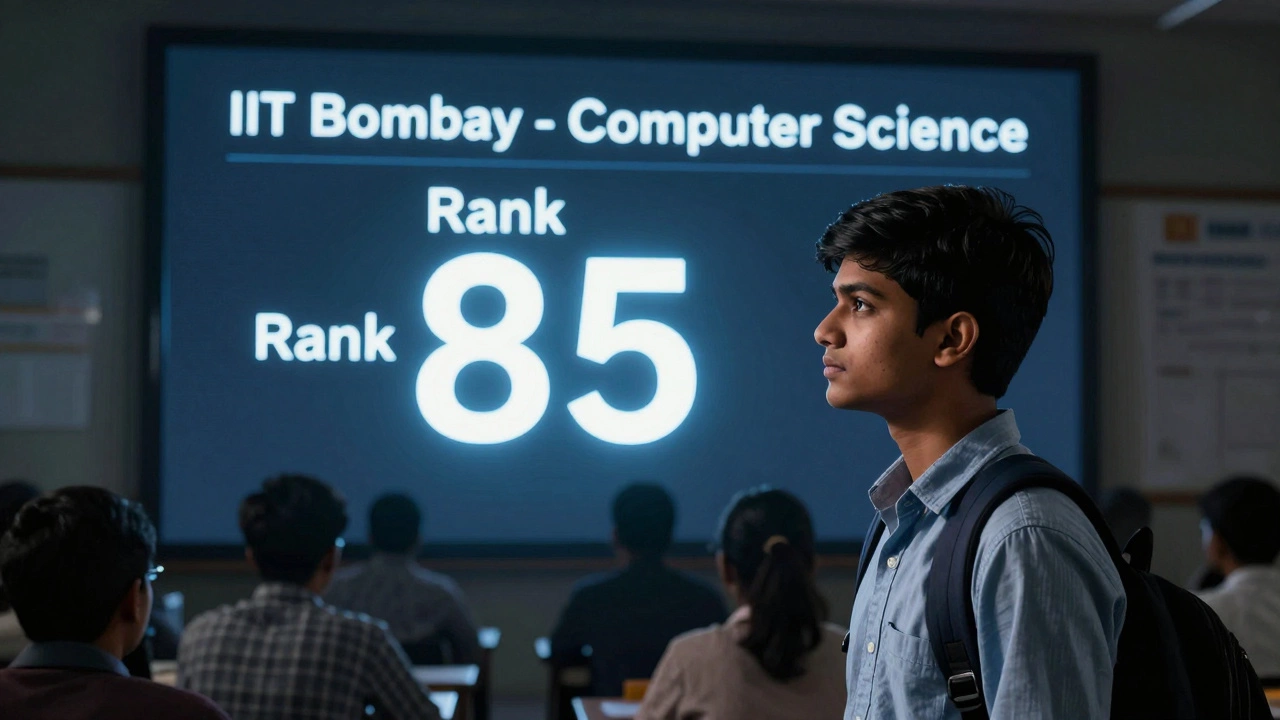
IIT Rank Estimator
This tool estimates your admission chances based on 2024 JEE Advanced cutoff data. It shows:
- Top 5 IITs Ranks: 1-500
- Newer IITs Ranks: 6,000-10,000
- Category Cutoffs 500-2,500 lower
Admission Analysis
Getting into an IIT isn’t just about studying hard-it’s about understanding the numbers. Every year, over 1.5 million students take JEE Main, and only about 250,000 qualify for JEE Advanced. From those, roughly 10,000 to 12,000 get seats across all IITs. But what rank do you actually need? It’s not one number. It changes every year, and it depends on which IIT and which branch you want.
What Does Your Rank Really Mean?
Your JEE Advanced rank is your position among all the students who cleared the exam. A rank of 1 means you were the top scorer. A rank of 5000 means 4,999 people scored higher than you. The lower the number, the better. This rank is what determines which IIT and which branch you can get into. There’s no direct percentage or score cutoff-it’s all about rank.
For example, if you score 280 out of 360, that might get you rank 800 one year and rank 1,500 the next. Why? Because the difficulty of the paper changes. The exam is normalized to account for this, so your rank is what matters, not your raw score.
Rank Requirements by IIT and Branch
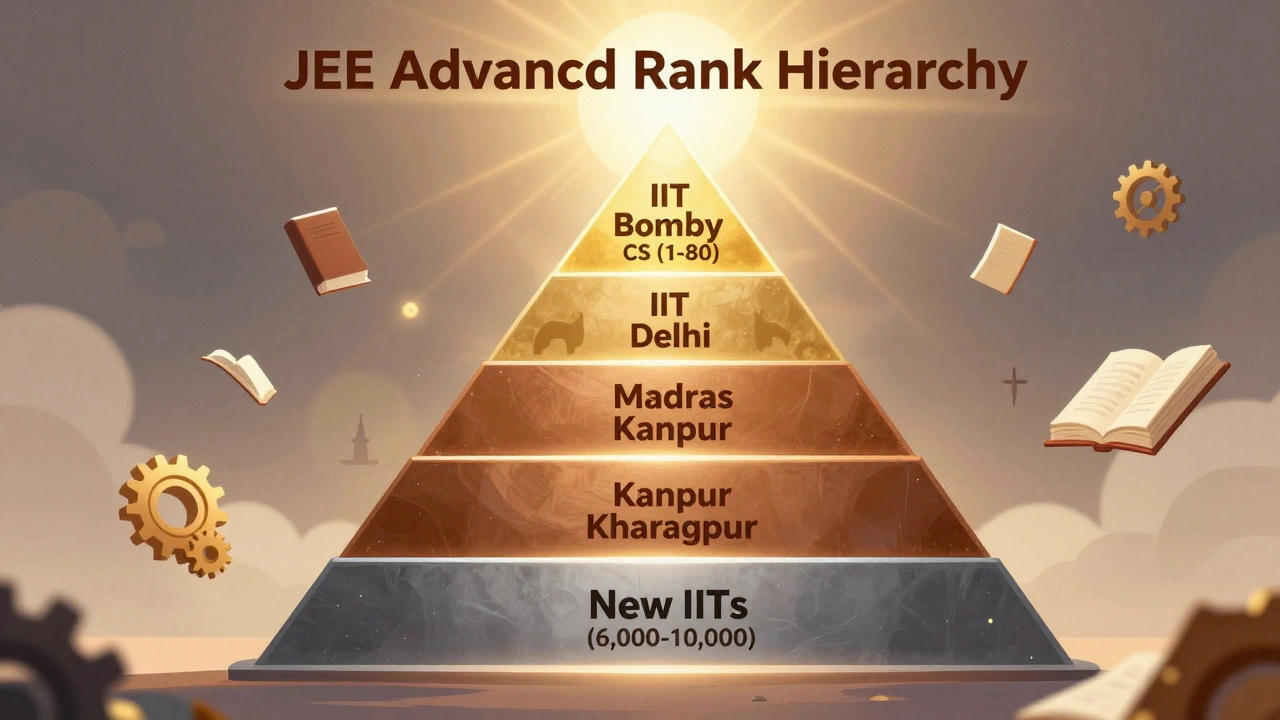
Not all IITs are the same. And not all branches are equal. The top 5 IITs-Bombay, Delhi, Madras, Kanpur, and Kharagpur-get the highest-ranked students. Here’s what recent trends show (based on 2024 data):
| IIT | Computer Science | Mechanical Engineering | Civil Engineering | Electrical Engineering |
|---|---|---|---|---|
| IIT Bombay | 1-80 | 80-300 | 800-1,500 | 100-400 |
| IIT Delhi | 1-100 | 100-400 | 1,000-2,000 | 150-500 |
| IIT Madras | 50-150 | 200-500 | 1,500-3,000 | 250-600 |
| IIT Kanpur | 100-200 | 300-700 | 2,000-4,000 | 400-800 |
| IIT Kharagpur | 150-300 | 500-1,000 | 3,000-5,500 | 600-1,200 |
Notice how Computer Science at IIT Bombay usually takes the top 80 ranks. That’s less than 1% of all qualified students. If you’re aiming for that, you need to be in the top 0.005% of all JEE Main takers. For Civil Engineering at IIT Kharagpur, you might need a rank around 4,500-still impressive, but much more attainable.
What If You Don’t Get Into the Top 5 IITs?
Many students think only the top 5 IITs matter. That’s not true. IIT Roorkee, IIT Guwahati, IIT BHU, and IIT Indore also offer world-class education. They have strong placements, great labs, and solid alumni networks. For example:
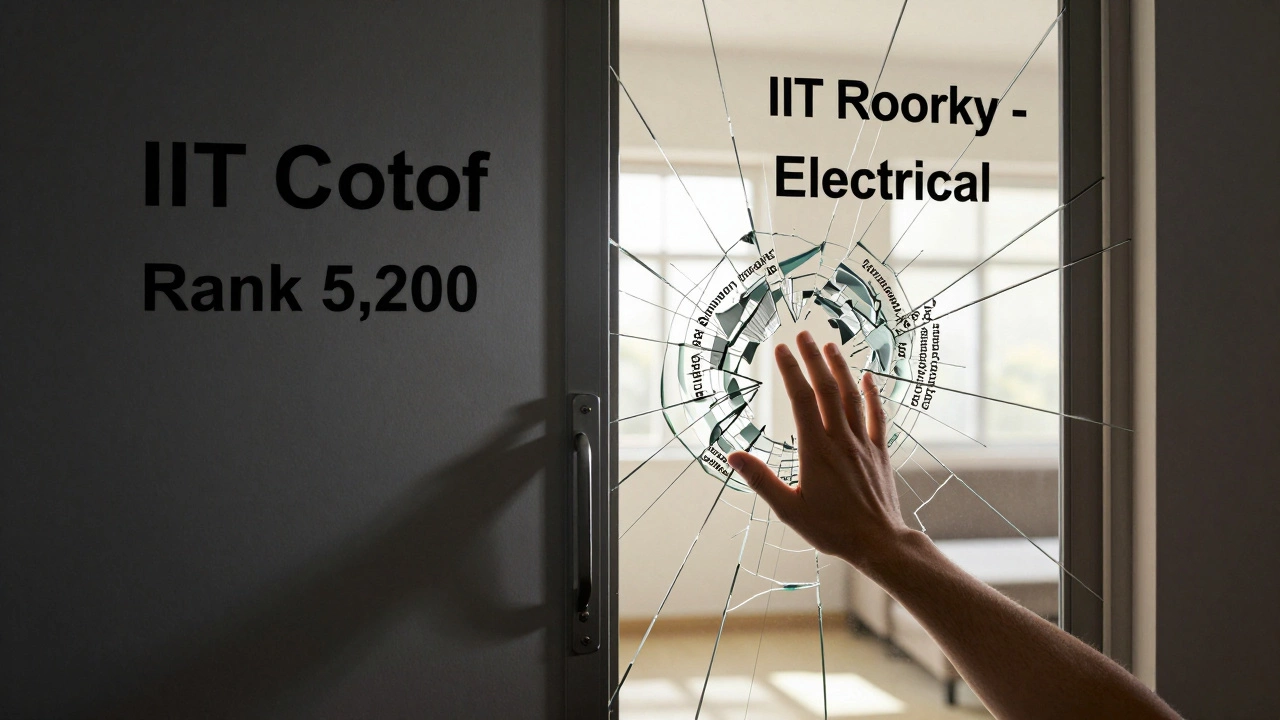
- IIT Roorkee: Electrical Engineering opens up around rank 1,000-2,200.
- IIT Guwahati: Chemical Engineering is available from rank 2,500-4,000.
- IIT BHU: Metallurgy and Materials Science can be accessed with a rank around 4,500-6,000.
These are not second choices-they’re top-tier programs. Many students from these IITs end up in Google, Microsoft, or top global research labs. The brand name matters less than what you do while you’re there.
What About Newer IITs?
Newer IITs like IIT Jammu, IIT Dharwad, IIT Palakkad, and IIT Tirupati are still building their reputations. But they’re growing fast. In 2024, their cutoff ranks were between 6,000 and 10,000. If you’re aiming for a seat in one of these, you’re still in the top 1% of all JEE Advanced candidates. That’s better than 99% of engineering students in India.
These IITs often have smaller batches, more faculty attention, and newer infrastructure. Many offer scholarships and early research opportunities. If you’re not getting into an older IIT, don’t give up. A newer IIT can still change your life.
How Do You Know If Your Rank Is Good Enough?
There’s no magic number. But here’s a simple way to check:
- Look up the opening and closing ranks from the previous year’s JoSAA counseling. These are published on the official JoSAA website.
- Compare your expected rank to the closing rank of your target branch at your target IIT.
- If your rank is within 500-800 ranks of the closing rank, you have a realistic shot.
- If it’s more than 1,000 ranks below, you’ll need to consider other branches or IITs.
For example, if IIT Delhi’s Electrical Engineering closed at 520 last year and you’re expecting a rank of 580, you’re still in the running. If you’re at 1,200, it’s unlikely unless you’re open to other branches like Physics or Mathematics.
What About Category Reservations?
If you belong to SC, ST, OBC-NCL, EWS, or PwD categories, your cutoff ranks are lower. For example:
- SC: Computer Science at IIT Bombay might close around rank 450.
- ST: Mechanical Engineering at IIT Madras might close around rank 800.
- OBC-NCL: Civil Engineering at IIT Kharagpur might close around rank 3,500.
These numbers vary yearly, but the gap between general and reserved category cutoffs is usually between 1,000 and 3,000 ranks. Always check the official JoSAA seat matrix for the most accurate numbers.
What If You Miss the Cutoff?
Missing the IIT cutoff doesn’t mean failure. Many students with ranks between 10,000 and 25,000 get into top NITs, IIITs, or state engineering colleges with excellent placements. IITs are prestigious, but they’re not the only path to success.
Some students who didn’t get into IITs ended up at BITS Pilani, Vellore Institute of Technology, or even abroad. Others cracked GATE, got into IISc Bangalore, or started successful startups. Your rank opens doors-but your effort after that opens the future.
Final Reality Check
If you’re aiming for Computer Science at IIT Bombay or Delhi, you need to be in the top 100 ranks. That’s a level of consistency most students don’t reach. But if you’re okay with other branches or newer IITs, a rank between 3,000 and 6,000 is very achievable with focused preparation.
Don’t fixate on one number. Focus on improving your problem-solving speed, mastering core topics like Calculus, Electrostatics, Organic Chemistry, and Thermodynamics, and practicing past papers under timed conditions. The rank will follow.
And remember: the students who get into IITs aren’t always the smartest. They’re the ones who showed up every day, learned from their mistakes, and didn’t give up when the pressure mounted.