
JEE/NEET Success Rate Calculator
Calculate Your Chances
Understand the true scale of competition for IIT JEE and NEET exams based on current statistics.
There’s a quiet moment before the exam hall doors open. Your hands are cold. Your stomach is tight. You’ve studied for 14 hours today, and tomorrow you’ll do it again. This isn’t a scene from a movie. It’s a Tuesday in a coaching center in Kota, Hyderabad, or Delhi. And for hundreds of thousands of students in India, this is the daily reality of chasing the most stressful degrees through the most brutal entrance exams.
Why IIT JEE and NEET Are Different From Regular Degrees
Most degrees-like a B.A. in History or a B.Com-ask you to learn, think, and write. IIT JEE and NEET don’t. They ask you to outperform 1.5 million others in a single day. The goal isn’t to understand physics or biology. It’s to solve 90 complex problems faster than anyone else, with zero room for error.There’s no second chance. One misread question, one skipped formula, one panic attack during the exam-and your dream of becoming an engineer or doctor vanishes. You’re not just studying for a degree. You’re training for a battle where the prize is a single seat out of 20,000.
Unlike university degrees where grades are spread over years, these exams compress years of effort into one 3-hour test. The pressure isn’t just academic. It’s social, financial, and emotional. Families sell land. Parents take second jobs. Siblings drop out. All to fund coaching fees that can cost ₹3-5 lakh per year.
The Numbers Don’t Lie
In 2025, over 1.8 million students took JEE Main. Only 25,000 cleared it to get into an IIT. That’s a 1.4% success rate. For NEET, more than 2.4 million applicants competed for 100,000 MBBS seats. Less than 4% made it.
These aren’t just statistics. They’re real people. A 2024 study by the Indian Journal of Psychological Medicine tracked 1,200 JEE aspirants over 18 months. 68% showed clinical signs of anxiety. 41% reported sleep deprivation lasting more than six months. 17% had considered self-harm at least once. These aren’t outliers. They’re the norm.
And the stress doesn’t end when you pass. Even after getting into an IIT or AIIMS, the pressure doesn’t lift. The first-year dropout rate at top engineering colleges is over 15%. Why? Because the students who made it here didn’t learn how to learn. They learned how to memorize under torture.
What Makes These Exams So Much Worse Than Others?
Compare JEE/NEET to GRE, GMAT, or even the US SAT. Those exams test reasoning, critical thinking, and English fluency. They’re designed to predict college success. JEE and NEET? They test endurance. Speed. Precision. Memory under fire.
There’s no syllabus review. No partial credit. No flexibility. If you don’t know the exact formula for the time period of a pendulum in a non-uniform gravitational field, you lose the mark. No explanation. No bonus. Just a red cross.
And the coaching ecosystem feeds this. Institutes like Allen, Resonance, and Aakash don’t just teach. They simulate war. Daily tests. Rank lists. Public shaming. Students are ranked from #1 to #20,000. Your worth is reduced to a number on a whiteboard. One month, you’re top 100. The next, you’re 5,000. And everyone sees it.

The Hidden Cost: Mental Health and Lost Years
Most students start preparing for JEE or NEET at age 14. That’s the year they enter Class 9. By 17, they’ve spent over 4,000 hours in coaching centers. That’s more time than most college students spend in class over four years.
They miss birthdays. Holidays. Friendships. First loves. They stop playing sports. Stop reading fiction. Stop dreaming beyond the next mock test. Their world shrinks to a desk, a textbook, and a timer.
A 19-year-old from Bhopal told a counselor, “I haven’t laughed in two years. My parents say, ‘Just one more year.’ But I don’t know what I’m living for anymore.” That’s not an exception. That’s a chorus.
Even when students succeed, many feel empty. “I got into IIT Bombay,” said a 2023 graduate. “But I didn’t choose engineering. My dad did. I just did what I was told. Now I’m here, and I hate every class.”
Is There a Better Way?
Some countries don’t have this problem. In Finland, there’s no standardized entrance exam for university. In Canada, grades from 11th and 12th matter. In Germany, you take the Abitur, a broad exam over months. No one is judged on a single day.
India’s system is a relic of the 1960s, designed when seats were scarce and merit was the only filter. But today, we have 500+ engineering colleges and 600+ medical colleges. We have AI, online learning, project-based assessments. Yet we still rely on a 1970s-style exam to decide who becomes a doctor or engineer.
Some reforms are starting. JEE Main now has two attempts per year. NEET has introduced a few multiple-choice questions with more than one correct answer. But the core remains unchanged: one test. One shot. One life decided.
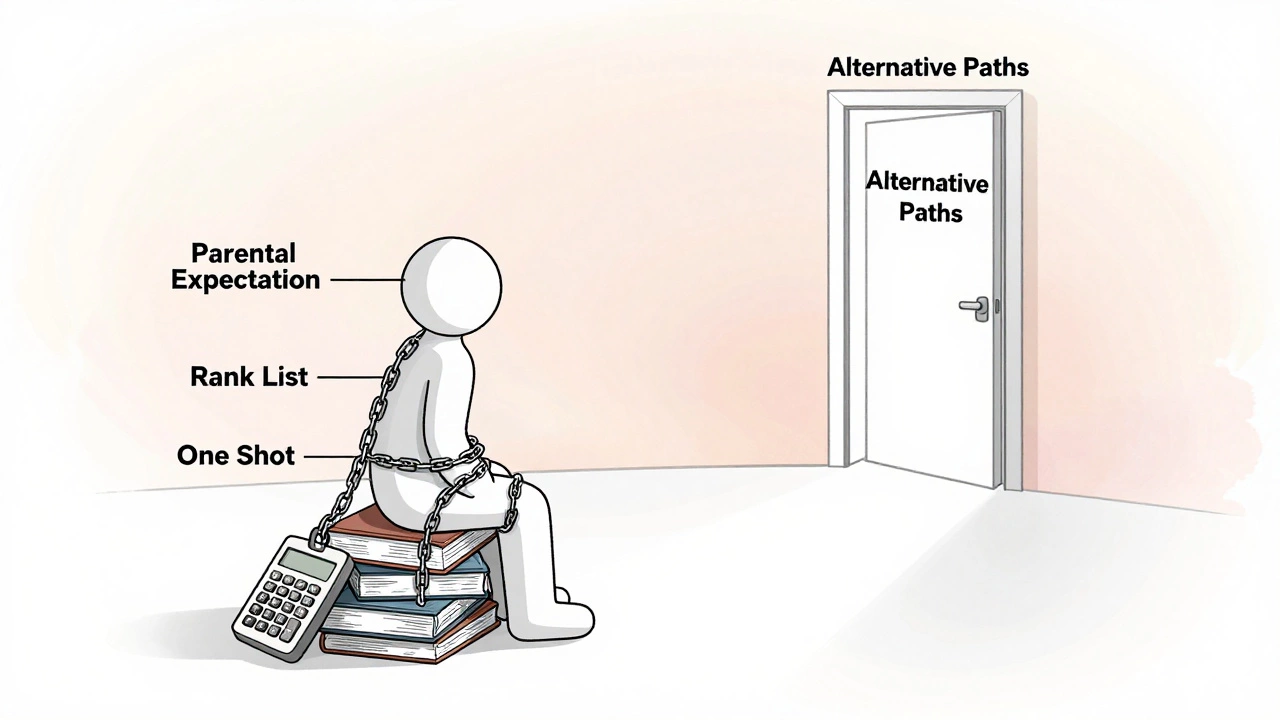
What Students Actually Need
What if we replaced the current system with something real? Like:
- Project-based evaluations in physics and chemistry during Classes 11 and 12
- Portfolios of lab work, coding projects, or community health initiatives
- Interviews with faculty to assess curiosity and problem-solving
- Multiple entry points-students could apply after Class 10, 12, or even after a gap year
These aren’t fantasy ideas. They’re already used in top global universities. But in India, change moves slowly. Because the coaching industry is worth over ₹1.2 lakh crore. And it thrives on fear.
What to Do If You’re in the Middle of It
If you’re studying right now, here’s the truth: your worth is not your rank. Your value is not in the number of hours you sleep. You are not a machine. You are a human being trying to survive a system that treats you like one.
Here’s what actually helps:
- Take one full day off every month. No books. No phone. Just walk. Listen to music. Eat something you love.
- Talk to someone who isn’t in the exam bubble. A teacher. A cousin. A stranger online. Just say, “I’m tired.”
- Keep a journal. Write down one thing you’re proud of each day-even if it’s “I drank water today.”
- Know this: if you don’t get into IIT or AIIMS, it doesn’t mean you failed. It means the system failed you.
There are thousands of doctors and engineers who didn’t go to IIT or AIIMS. They built clinics. They invented devices. They taught in rural schools. They changed lives. Their path was harder. But it was theirs.
Final Thought: The Degree Isn’t the Prize
The real prize isn’t the seat in IIT or AIIMS. It’s the ability to wake up tomorrow and still believe you’re enough-even if you didn’t get the rank you wanted.
The most stressful degree isn’t the one you study. It’s the one you’re forced to chase.
Is IIT JEE the most stressful exam in India?
Yes, by most measures. With over 1.8 million applicants and only 25,000 seats in IITs, the selection rate is below 1.5%. The pressure comes from the high stakes, the single-exam format, the coaching industry’s intensity, and societal expectations. Studies show over 60% of aspirants experience clinical anxiety. No other exam in India combines such scale, speed, and social weight.
How does NEET compare to JEE in terms of stress?
NEET is just as stressful, if not more. While JEE has around 1.8 million applicants, NEET draws over 2.4 million. The stakes are higher because medical seats are fewer per applicant, and the emotional weight of becoming a doctor adds pressure. Many students see NEET as a path to family honor and financial security, not just a career. The dropout rate after clearing NEET is also higher due to burnout.
Do students who crack JEE or NEET end up happier?
Not necessarily. Many students who clear these exams suffer from identity loss. They spent years chasing a goal they didn’t choose. Studies show 30-40% of IIT and AIIMS students report feeling disconnected from their courses. Happiness comes from autonomy, not achievement. Those who enter because they’re passionate tend to thrive. Those who enter because they had to, often struggle.
Are there alternatives to JEE and NEET for engineering or medicine?
Yes. For engineering, you can get into private colleges through state-level exams like MHT-CET, KCET, or even direct admissions based on 12th-grade marks. For medicine, some states offer admission through state NEET scores with lower cutoffs. Overseas options like MBBS in Ukraine or Georgia are also growing. But these paths are less visible, less celebrated, and often seen as second-choice-even though they lead to the same profession.
What can parents do to reduce stress for their child preparing for JEE or NEET?
Stop measuring success by rank. Ask your child, “How are you feeling today?” instead of “What’s your rank?” Allow them to take breaks. Don’t compare them to cousins or neighbors. Help them find a counselor if they show signs of depression or anxiety. Remember: your child is not a project. They’re a person. Their mental health matters more than a college name.
Is it worth taking a drop year for JEE or NEET?
It’s risky. A drop year doubles the pressure. The coaching centers push it because they profit from it. But statistically, only 20-25% of dropouts improve significantly. Most burn out. Many lose motivation. If you’re taking a drop, do it for the right reasons-not because your parents expect it. And have a backup plan. No exam is worth your mental health.