
Vocational vs Academic Path Finder
Your Career Path Decision Tool
Answer these questions to find the path that best matches your goals, budget, and learning style.
Answer the questions above to see your recommended path.
People often use the words vocational and educational like they mean the same thing. But they don’t. If you’re trying to decide what to study after school, or looking to switch careers, mixing them up could cost you time, money, and opportunity.
Vocational Training Is About Doing, Not Just Knowing
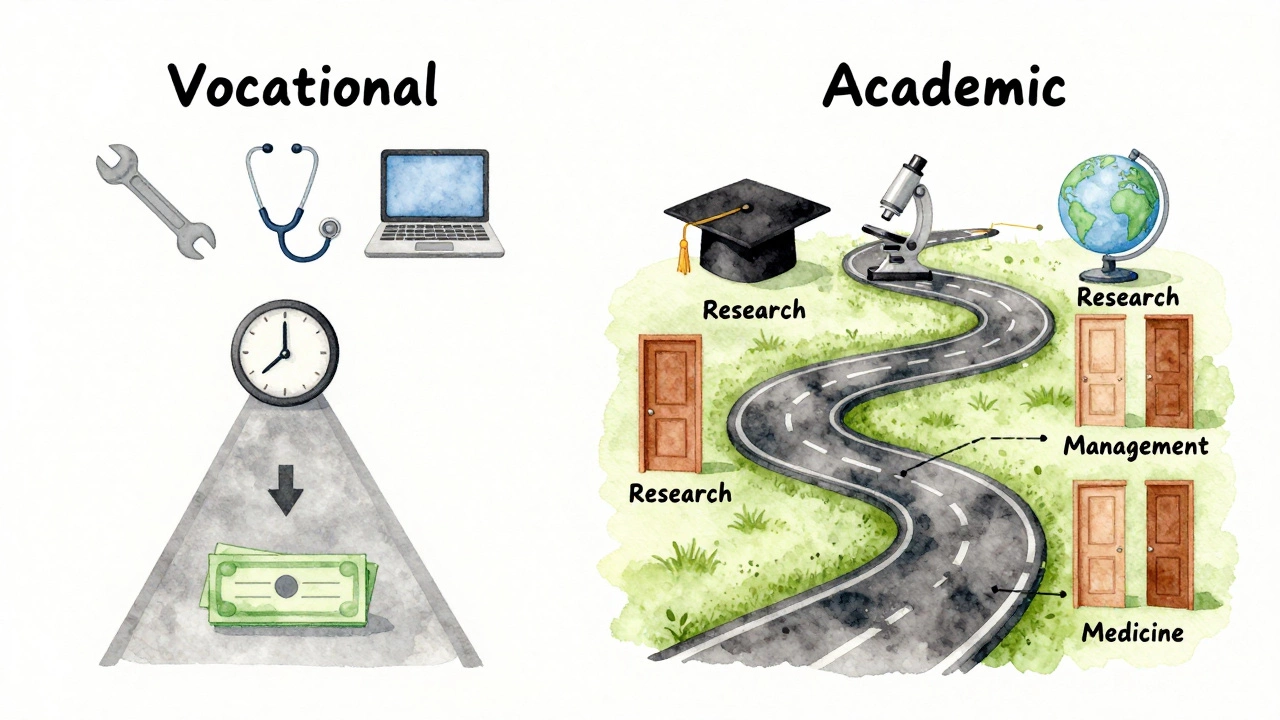
Vocational training teaches you how to do a specific job. It’s hands-on. You learn by doing. A welding course doesn’t spend weeks on the history of metallurgy-it shows you how to set up a torch, read blueprints, and make strong joints that pass safety checks. A certificate in automotive repair trains you to diagnose engine problems, replace brake pads, and reset error codes on modern cars.
These programs are built around industry needs. In Australia, vocational courses like Certificate III in Electrotechnology or Diploma of Nursing are designed with input from employers. The curriculum changes when the job changes. If electricians now need to install solar panels, the course adds it. No delays. No theory-heavy textbooks. Just what you need to start working.
Most vocational courses take six months to two years. You don’t need to pass entrance exams like the UCAT or ATAR. You just need to show up, learn, and pass practical assessments. Many students finish with a job offer already lined up.
Educational Paths Focus on Theory, Analysis, and Broader Knowledge
When we say "educational," we usually mean academic learning-university degrees, bachelor’s programs, postgraduate studies. These paths are built on expanding your understanding of ideas, not just learning how to perform tasks.
A Bachelor of Science in Biology isn’t about how to run a lab test. It’s about understanding evolution, genetics, cellular processes, and ecological systems. You read research papers, write essays, debate ethical dilemmas, and learn how to think critically. The goal isn’t to become a lab technician right away-it’s to build a foundation for future roles in research, policy, medicine, or education.
These programs take longer. A typical bachelor’s degree is three to four years. You pay higher fees. You sit through lectures, write exams, and complete assignments that might not feel connected to real-world work until years later. But the outcome? A degree that opens doors to professions requiring formal accreditation-like doctors, lawyers, engineers, or university lecturers.
Who Each Path Serves
Vocational training works best for people who want to enter the workforce quickly, enjoy working with their hands, or are drawn to trades like plumbing, carpentry, hairdressing, or IT support. It’s also ideal if you’ve already decided on a specific job title and just need the skills to get there.
Academic education suits those who want flexibility, enjoy deep thinking, or plan to move into leadership, research, or roles that require advanced qualifications. Want to become a teacher? You need a bachelor’s degree in education. Want to design buildings? You need an engineering degree. These aren’t optional-they’re legal requirements.
There’s also a big difference in cost. In Australia, vocational courses under the Smart and Skilled program can cost as little as $100-$500 for eligible students. A university degree? $10,000-$40,000 per year. That’s not just a difference in price-it’s a difference in risk.

Job Outcomes: Speed vs. Scope
Let’s compare two people:
- Sam finishes a Certificate IV in Information Technology in 12 months. Gets hired as a helpdesk technician at $65,000/year. Starts fixing computers next week.
- Jessica spends four years getting a Bachelor of Computer Science. Graduates with a 2.8 GPA. Applies for 40 jobs. Lands a junior developer role at $72,000 after six months of searching.
Sam got paid faster. Jessica has more long-term options-she can later move into cybersecurity, AI, or management. But she waited. And paid more.
Vocational paths give you a direct ticket to a job. Academic paths give you a key to many doors-but you have to find the right one first.
Can You Switch Between Them?
Yes. And more people are doing it.
Many vocational graduates go on to university later. A Certificate III in Early Childhood Education can lead to a Bachelor of Teaching. A Diploma in Business can count as credit toward a bachelor’s degree. Universities in Australia recognize vocational qualifications through Recognition of Prior Learning (RPL).
And vice versa-some university dropouts go into vocational training to gain practical skills. A student who leaves a commerce degree might enroll in a Certificate IV in Accounting to get a job while deciding their next step.
The old idea that you pick one path at 18 and stick with it is outdated. Today, people switch between vocational and academic learning multiple times in their careers.
Myths That Hold People Back
Myth 1: "Vocational courses are for people who aren’t smart enough for university." That’s false. Vocational training requires precision, problem-solving, and adaptability. A qualified electrician needs to understand circuit theory, safety regulations, and local building codes. They’re not less intelligent-they’re skilled in a different way.
Myth 2: "University degrees guarantee better jobs." Not anymore. In Australia, trades like plumbing, refrigeration, and electrical work often pay more than entry-level graduate jobs. The average plumber earns $90,000+ annually. Many university graduates start at $55,000 and work their way up.
Myth 3: "You can’t get a good career without a degree." Check the Australian Job Outlook data: 7 of the top 10 fastest-growing jobs in the next five years are in skilled trades. Carpenters, welders, aged care workers, and IT support technicians-all require vocational training, not degrees.
How to Decide: Ask Yourself These Questions
- Do I want to start earning within a year? → Choose vocational.
- Do I want to work with my hands or solve real problems on the job? → Choose vocational.
- Do I want to become a doctor, lawyer, or professor? → Choose academic education.
- Am I okay with studying for years before I earn a salary? → Choose academic.
- Do I want to keep my options open for management, research, or international work? → Academic gives more flexibility.
- Am I on a tight budget? → Vocational is cheaper and often government-subsidized.
There’s no right or wrong path. Only the right path for your goals, your life, and your money.
What’s Changing in 2025
More universities now offer dual pathways. You can start with a vocational diploma and transfer into a degree. Some TAFE institutions in NSW and Victoria now offer bachelor’s degrees in areas like nursing, cybersecurity, and building design.
Employers are also shifting. Companies like Telstra, BHP, and Coles now hire based on skills, not just degrees. They use digital badges and micro-credentials from platforms like Coursera and LinkedIn Learning to assess applicants.
The future isn’t about choosing between vocational and academic. It’s about mixing both. Learn a trade. Then study management. Get a certificate. Then earn a degree. Build your path step by step.
Is vocational training better than university?
Neither is better-it depends on your goals. Vocational training gets you into a job faster and costs less. University gives you broader knowledge and access to professions that require degrees. Choose based on the job you want, not what others expect.
Can I go to university after a vocational course?
Yes. Many Australian universities give credit for vocational qualifications through Recognition of Prior Learning (RPL). A Diploma of Business might count as one year of a bachelor’s degree. Always check with the university you’re applying to.
Do employers value vocational certificates?
Absolutely. In skilled trades, healthcare, IT support, and hospitality, employers prioritize certificates and hands-on experience over degrees. A Certificate III in Electrotechnology is a requirement for electricians-not a bonus.
Are vocational courses only for people who didn’t do well in school?
No. Many high-achieving students choose vocational paths because they want to work, earn, and build real skills without debt. Others choose them because they learn better by doing, not by memorizing for exams.
What’s the difference between TAFE and university?
TAFE (Technical and Further Education) delivers vocational training-certificates and diplomas focused on jobs. Universities offer academic degrees focused on theory, research, and critical thinking. TAFE is shorter, cheaper, and job-focused. University is longer, more expensive, and prepares you for professions requiring formal accreditation.