
Vocational Career Path & ROI Calculator
Your Vocational Outlook
Recommended Path
Certificate IIISkilled operational tasks. Typical duration: 1 year.
Focus: Tradesperson (e.g., Electrician, Chef)
Return on Investment
120%
Estimated first-year ROI after graduation
Net Cost to Start: $12,000
You finish high school. The pressure is on. Everyone talks about university degrees as the only path to success. But what if you want to build things with your hands, work with technology, or start earning money sooner rather than later? This is where a vocational qualification comes in. It’s not just a backup plan; it’s a direct route to a skilled career.
In Australia, we have one of the most robust vocational education systems in the world, known as VET (Vocational Education and Training). Globally, these qualifications are often called diplomas, certificates, or trade licenses. They focus on practical skills rather than abstract theory. If you’ve ever wondered how electricians, chefs, or IT technicians get certified, they usually hold a vocational qualification.
Defining the Core: What Actually Is a Vocational Qualification?
A vocational qualification is a formal credential that proves you have the specific skills and knowledge to perform a particular job. Unlike a bachelor’s degree, which might teach you the history of economics, a vocational course teaches you how to balance a ledger or run a payroll system right now.
Think of it this way: A university degree gives you a broad foundation. A vocational qualification gives you a sharp tool. When you earn this credential, employers know exactly what you can do. For example, a Certificate III in Electrical Engineering doesn’t just say you studied electricity; it says you are legally allowed to wire a house safely.
Is a vocational qualification the same as a trade license?
Not always. A vocational qualification is the educational certificate you earn from a college or training provider. A trade license is a legal permit issued by the government that allows you to practice that trade. Often, you need the qualification to apply for the license.
The beauty of these qualifications is their specificity. They are designed by industry experts, not just academics. This means the curriculum changes as the industry changes. If software coding standards shift, the vocational IT course updates its modules within months. Universities often take years to revise their syllabi.
The Hierarchy of Vocational Credentials
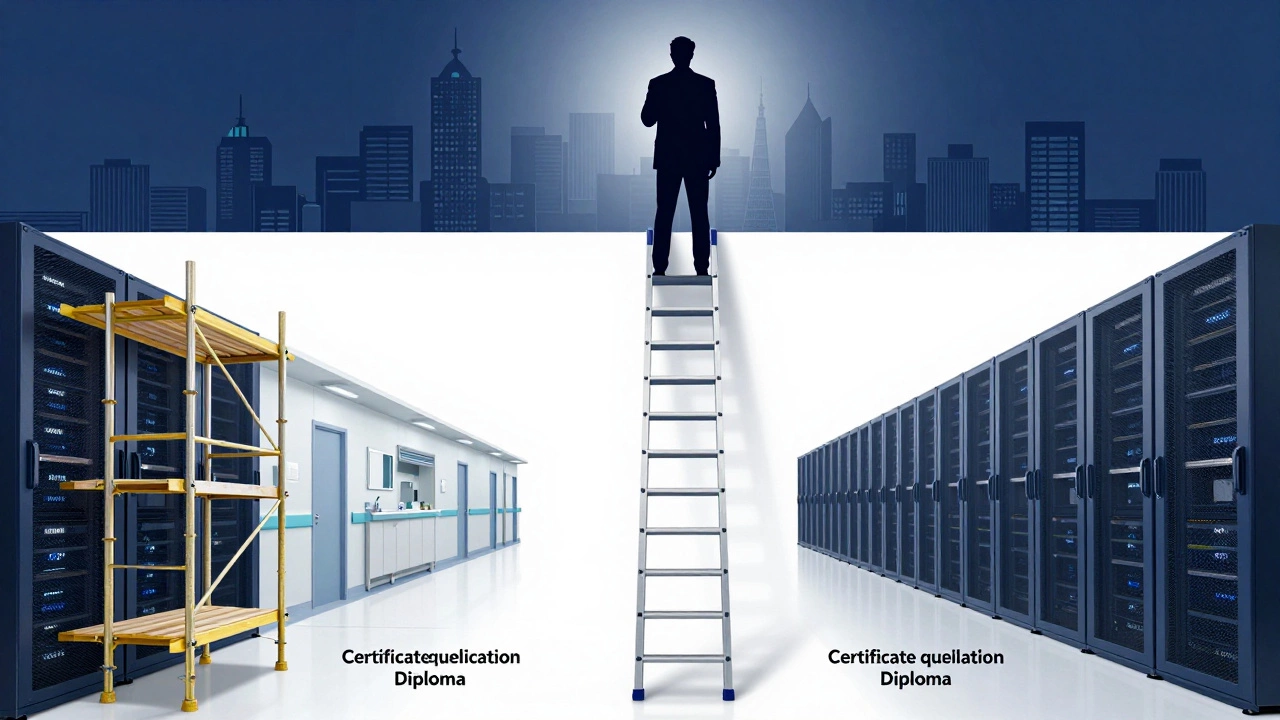
One common mistake people make is thinking all vocational qualifications are the same. They aren’t. In many countries, including Australia, there is a clear ladder. Understanding this hierarchy helps you choose the right starting point for your career goals.
| Level | Focus | Typical Duration | Career Outcome |
|---|---|---|---|
| Certificate I & II | Basic skills, workplace induction | 3-6 months | Entry-level roles, volunteer positions |
| Certificate III | Skilled operational tasks | 1 year | Tradesperson (e.g., Electrician, Chef) |
| Certificate IV | Supervisory skills, complex tasks | 1-2 years | Team Leader, Senior Technician |
| Diploma | Advanced technical knowledge | 2 years | Managerial roles, Specialist Consultant |
| Advanced Diploma | High-level strategic application | 2-3 years | Senior Management, Business Owner |
If you want to become a plumber, you likely start with a Certificate III. If you want to manage a construction site, you might aim for a Diploma in Civil Construction. Knowing where you want to end up determines where you should begin.
Vocational vs. Academic: Choosing Your Path
Let’s address the elephant in the room. Society often places academic degrees above vocational training. This is a outdated view. The choice isn’t about intelligence; it’s about learning style and career speed.
Academic paths are great for research, law, medicine, and theoretical sciences. They require deep study of concepts over four or more years. Vocational paths are ideal for applied skills. You learn by doing. You spend time in workshops, kitchens, hospitals, or offices practicing real tasks.
Consider the cost. University tuition can be tens of thousands of dollars per year, plus living expenses while you study full-time. Many vocational courses allow you to work part-time because they are shorter or offered in the evenings. Some even offer apprenticeships where you earn a wage while you learn. By the time a university graduate is paying off debt, a vocational graduate might already have three years of experience and savings.
However, don’t think vocational doors are closed forever. Many vocational qualifications provide credit toward university degrees later. You can start with a Diploma in Nursing and then transfer into a Bachelor of Nursing. It’s a flexible bridge, not a dead end.

Top Industries Hiring Vocational Graduates
Which fields value these qualifications the most? Surprisingly, almost every essential service relies on them. Here are the sectors with the highest demand for skilled workers in 2026:
- Construction and Trades: Electricians, plumbers, carpenters, and welders are consistently in short supply. These jobs pay well and offer job security because buildings always need maintenance.
- Healthcare Support: While doctors need medical degrees, the healthcare system runs on enrolled nurses, aged care workers, and disability support workers. These roles require vocational certificates and offer immense personal reward.
- Hospitality and Tourism: Chefs, bartenders, and hotel managers often rise through vocational ranks. The skills are portable; you can cook anywhere in the world.
- Information Technology: Network administrators, cybersecurity analysts, and helpdesk technicians often start with vocational diplomas. Tech moves too fast for some traditional CS degrees to keep up with practical needs.
- Automotive: Mechanics and EV (electric vehicle) technicians are critical. As cars become more computerized, the blend of mechanical and digital skills taught in vocational auto courses is gold.
These aren’t “lesser” jobs. They are the backbone of the economy. Without them, hospitals close, power grids fail, and food stops being served.
How to Choose the Right Vocational Course
Picking a course feels overwhelming. There are hundreds of options. Here is a simple checklist to narrow it down:
- Check Accreditation: Ensure the provider is registered. In Australia, look for an RTO (Registered Training Organisation). An unaccredited certificate is worthless to employers.
- Look for Work-Integrated Learning: Does the course include an internship, placement, or apprenticeship? Hands-on experience is the biggest factor in getting hired.
- Research Industry Recognition: Talk to people already in the job. Ask them, “What qualification did you use to get started?” If they say “experience,” find a course that prioritizes projects over exams.
- Consider Cost vs. Return: Calculate the total cost of the course against the starting salary of the role. If a course costs $15,000 but the entry-level job pays $40,000 a year, it’s a good investment. If it costs $20,000 for a job paying $25,000, rethink it.
Don’t just follow trends. Don’t pick coding because it’s popular if you hate logic puzzles. Don’t pick hospitality if you can’t stand being on your feet for eight hours. Match the skill to your personality.
Myths About Vocational Training
Misinformation holds many people back. Let’s clear up the biggest lies.
“It’s only for people who failed at school.” False. Some of the most successful entrepreneurs and skilled tradespeople were top students who chose practical careers. Intelligence comes in many forms, including spatial reasoning and manual dexterity.
“You’ll hit a career ceiling.” False. Many vocational graduates move into management, business ownership, or specialized consulting. A chef can open a restaurant. An electrician can start a contracting firm. The skills give you autonomy.
“AI will replace these jobs.” Unlikely in the near future. AI can write code or analyze data, but it cannot fix a leaking pipe in a flooded basement or comfort a distressed elderly patient. Jobs requiring physical presence and human empathy are safe.
Frequently Asked Questions
Can I study vocational courses online?
Yes, but with limits. Theory-based components of courses like administration, IT, or business can be done online. However, courses requiring physical skills like plumbing, cooking, or nursing require face-to-face workshops or clinical placements to ensure safety and competency.
Do vocational qualifications expire?
The qualification itself does not expire. However, in regulated industries like healthcare or childcare, you must renew your working with children checks or professional registrations annually. Keeping your skills updated through short courses is also recommended.
Are vocational qualifications recognized internationally?
It depends on the country. Australian vocational qualifications (AQF) are highly respected globally, especially in trades and healthcare. However, you may need to undergo a skills assessment or obtain local licensing to work in another country. Always check the immigration requirements of your target destination.
What is the difference between TAFE and private colleges?
TAFE (Technical and Further Education) institutions are government-owned and often subsidized, making them cheaper. Private colleges may offer more flexible schedules, newer facilities, or niche specializations, but they can be more expensive. Both issue nationally recognized qualifications if they are registered RTOs.
Can I get financial help for vocational training?
In many countries, yes. In Australia, programs like Smart and Skilled offer free or low-cost training for residents in high-demand sectors. Scholarships and apprenticeships also provide funding. Check your local government’s education website for current subsidies.