
Python Learning Path Estimator & Quiz
Select your current experience level to see how long it might take to reach proficiency.
Q1: Which line correctly prints "Hello" in Python?
Q2: How do you define a variable in Python?
Q3: What is used to structure code blocks in Python?
You’ve probably heard it a thousand times: "Just learn Python." It’s the go-to recommendation for everyone from high school students in Sydney to career changers in Silicon Valley. But if you’re staring at your screen right now, wondering if you have what it takes to code, that advice feels less like a helpful tip and more like a dare. So, is Python actually hard to learn?
The short answer? No. The long answer? It depends entirely on what you want to build and how you approach it. Unlike C++, which forces you to manage every byte of memory yourself, or Java, which requires a lot of boilerplate code before you see anything happen, Python reads almost like English. That simplicity is its superpower, but it can also be a trap if you don’t understand where the real challenges lie.
Why Python Feels Easier Than Other Languages
Let’s look at why Python has become the default entry point for programming education. When you compare it to older languages, the difference isn’t just aesthetic; it’s structural. In many languages, you spend hours fighting with syntax errors-missing semicolons, mismatched brackets, or complex type declarations-before you even get to solve the actual problem. Python strips all that away.
Consider this simple task: printing "Hello, World!" to the screen. In Java, you need to define a class, write a main method, and use specific system output commands. That’s five lines of code minimum. In Python, it’s one line: print("Hello, World!"). This low barrier to entry means you spend less time wrestling with the language rules and more time thinking about logic. For beginners taking coding classes, this immediate feedback loop is crucial. You see results instantly, which keeps motivation high when the concepts get tricky.
| Feature | Python | Java | C++ |
|---|---|---|---|
| Print Statement | print() |
System.out.println() |
std::cout << |
| Variable Declaration | Implicit (dynamic typing) | Explicit type required | Explicit type required |
| Memory Management | Automatic (Garbage Collection) | Automatic (Garbage Collection) | Manual or Smart Pointers |
| Indentation | Mandatory for structure | Optional (style only) | Optional (style only) |
The Hidden Challenges: Where Beginners Actually Struggle
If Python is so easy, why do people quit? It’s not because they can’t read the code. It’s because programming isn’t really about writing code; it’s about solving problems. And that part is hard, regardless of the language.
The biggest hurdle for new learners is usually logic construction. You might understand what a loop does, but figuring out how to structure nested loops to filter a dataset without crashing your program is a different beast. Another common pain point is understanding data structures like lists, dictionaries, and sets. Python makes them easy to create, but using them efficiently requires a shift in thinking. For example, realizing that checking if an item exists in a list is slow (O(n) complexity) compared to a set (O(1) complexity) is a concept that trips up many self-taught coders.
Then there’s the issue of error messages. Python’s tracebacks are famously verbose. When something goes wrong, you get a wall of text pointing to the exact line number. For a beginner, this can feel overwhelming rather than helpful. Learning to read these errors is a skill in itself, often overlooked in introductory tutorials that focus too much on "happy path" coding where everything works perfectly.
How Your Background Changes the Difficulty
Not everyone starts from zero. Your prior experience significantly impacts how "hard" Python feels.
- Total Beginners: If you’ve never coded before, the hardest part isn’t Python syntax-it’s computational thinking. You need to learn how to break big problems into small steps. Expect to spend 3-6 months getting comfortable with basics.
- Excel Power Users: If you know advanced formulas and VLOOKUPs, you’ll grasp data manipulation quickly. Libraries like Pandas will feel like familiar territory. You can likely reach proficiency in 2-3 months.
- Web Developers (HTML/CSS): You understand structure and hierarchy, which helps with object-oriented programming concepts. However, backend logic and server-side interactions will still be new ground.
- Experienced Programmers (from JS/PHP): You’ll pick up Python syntax in a weekend. The challenge here is unlearning habits from other languages, like trying to force Python to behave like JavaScript.
This variability is why generic timelines online are useless. One person learns faster because they think logically; another struggles because they lack patience for debugging. Be honest about where you’re starting from.
Self-Study vs. Coding Classes: What Works Best?
Should you buy a book, watch YouTube tutorials, or enroll in formal coding classes? This decision matters more than the language choice.
Self-study offers flexibility and costs little. Platforms like Coursera or freeCodeCamp provide structured paths. However, the dropout rate for self-paced online courses is notoriously high-often cited around 90%. Why? Because no one checks if you’re stuck. You hit a bug, stare at it for three hours, and quit out of frustration.
Formal classes, whether online or in-person, provide accountability. Having a mentor who can say, "Hey, you’re overcomplicating this," saves days of wasted effort. In Australia, many bootcamps and TAFE courses offer structured Python introductions that include project-based assessments. These force you to apply concepts rather than just memorize syntax. If you struggle with discipline, investing in a guided course is often cheaper in the long run than wasting six months going nowhere on your own.
Real-World Applications Make It Worth It
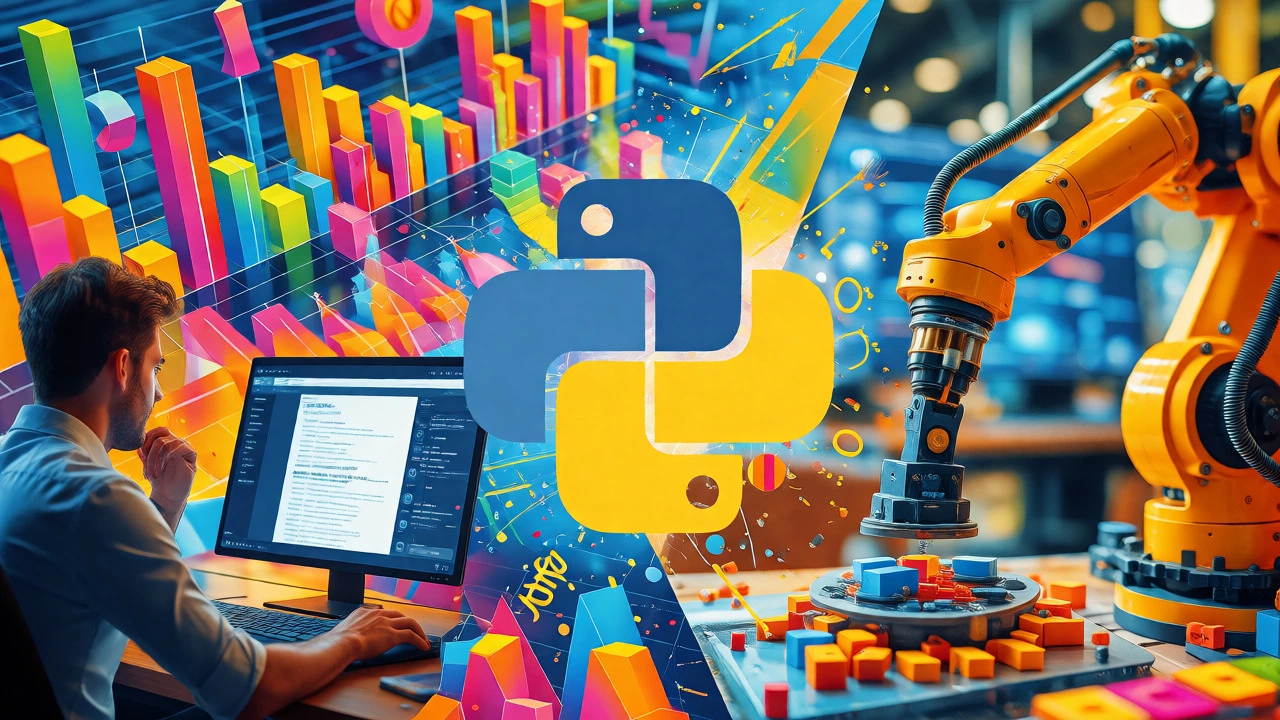
People don’t learn Python for fun (well, most don’t). They learn it because it opens doors. The reason Python remains popular isn’t just its ease of use; it’s its versatility. Once you get past the basics, you can pivot into several high-demand fields without learning a new language.
Data Science is the biggest driver. Tools like NumPy and Matplotlib let you analyze massive datasets and visualize trends effortlessly. If you’re interested in finance or marketing analytics, this is your playground.
Web Development is another major area. Frameworks like Django and Flask allow you to build robust websites quickly. Django, in particular, follows a "batteries-included" philosophy, meaning authentication, database management, and admin panels come ready to use. This reduces the cognitive load for developers building full-stack applications.
Finally, Automation scripts save countless hours. Need to rename 500 files? Send emails automatically? Scrape data from a website? Python handles these tasks with minimal code. This immediate utility keeps learners engaged because they see tangible benefits early on.
A Practical Roadmap to Learning Python
So, how do you actually learn it without burning out? Here’s a strategy that works better than just reading documentation.
- Master the Basics (Weeks 1-4): Focus on variables, data types, loops, conditionals, and functions. Don’t worry about best practices yet. Just make things work.
- Build Small Projects (Weeks 5-8): Stop following tutorials blindly. Build a calculator, a to-do list, or a simple game like Tic-Tac-Toe. You’ll encounter bugs you didn’t expect, which teaches you debugging.
- Learn One Library Deeply (Months 3-4): Pick a direction. If you like data, dive into Pandas. If you like web, try Flask. Depth beats breadth at this stage.
- Understand Object-Oriented Programming (Month 5): Classes and objects confuse many beginners. Spend time understanding why we use them-to organize code and reuse logic-not just how to write them.
- Contribute or Collaborate (Month 6+): Look at open-source projects or join a local meetup. Seeing how others structure their code exposes you to professional standards.
Remember, consistency beats intensity. Coding for 30 minutes every day is far more effective than cramming for eight hours once a week. Your brain needs sleep to consolidate what you’ve learned.
Frequently Asked Questions
How long does it take to learn Python basics?
For most beginners studying part-time (5-10 hours a week), it takes about 4-8 weeks to grasp the core syntax and basic logic. Reaching a level where you can build functional applications typically takes 3-6 months of consistent practice.
Do I need math skills to learn Python?
No, you don’t need advanced math for general programming. Basic arithmetic and logical reasoning are sufficient. However, if you aim for Data Science or Machine Learning, a stronger foundation in statistics and linear algebra becomes important later on.
Is Python good for getting a job?
Yes, Python is one of the most requested skills in the tech industry. Roles in data analysis, backend development, DevOps, and automation heavily favor Python knowledge. Its versatility makes it a safe bet for career stability.
What is the hardest part about learning Python?
The syntax is rarely the hardest part. Most learners struggle with problem-solving-breaking down complex tasks into code-and understanding abstract concepts like recursion, object-oriented design, and asynchronous programming.
Can I learn Python by myself?
Absolutely. Many successful developers are self-taught. However, you need strong self-discipline and access to quality resources. Joining communities like Stack Overflow or Reddit’s r/learnpython can help fill the gap left by not having a teacher.