Coding Path Finder
Not sure where to start? Select what you want to build, and we'll recommend the best language and a starting project for you.
Language Name
Description of why this is a good choice.
The Great Coding Fear
You've probably seen the memes: a developer staring at a screen with a single missing semicolon, looking like they're solving a quantum physics equation. Or maybe you've heard a friend describe their job as 'basically just Googling things for eight hours a day.' It makes you wonder: is coding for beginners actually a mountain you can climb, or is it a wall designed to keep people out?
Here is the reality: coding isn't 'hard' in the way that advanced calculus is hard. It's a different kind of difficult. It's more like learning a musical instrument or a new language. At first, your fingers don't know where to go, and the sounds you make are awkward. But once you understand the rhythm, it becomes a tool for creation. If you can follow a recipe to bake a cake or organize a folder on your desktop, you already have the basic logic needed to program.
Why People Think It's Impossible
Most people hit a wall not because they aren't 'smart enough,' but because they start with the wrong tools. Imagine trying to learn Spanish by reading a 19th-century legal textbook. You'd quit in an hour and decide you're just bad at languages. That's what happens when beginners jump straight into C++ or Java without understanding the basics of logic. These languages are powerful, but they have strict rules (called syntax) that can feel punishing to a newcomer.
Then there's the "imposter syndrome." You see a project on GitHub with 10,000 lines of code and feel like you'll never get there. But remember, that project wasn't written in one sitting. It was built one tiny, broken piece at a time. The difficulty isn't in the complexity of the final product, but in the frustration of the first few bugs that refuse to go away.
The Learning Curve: What to Actually Expect
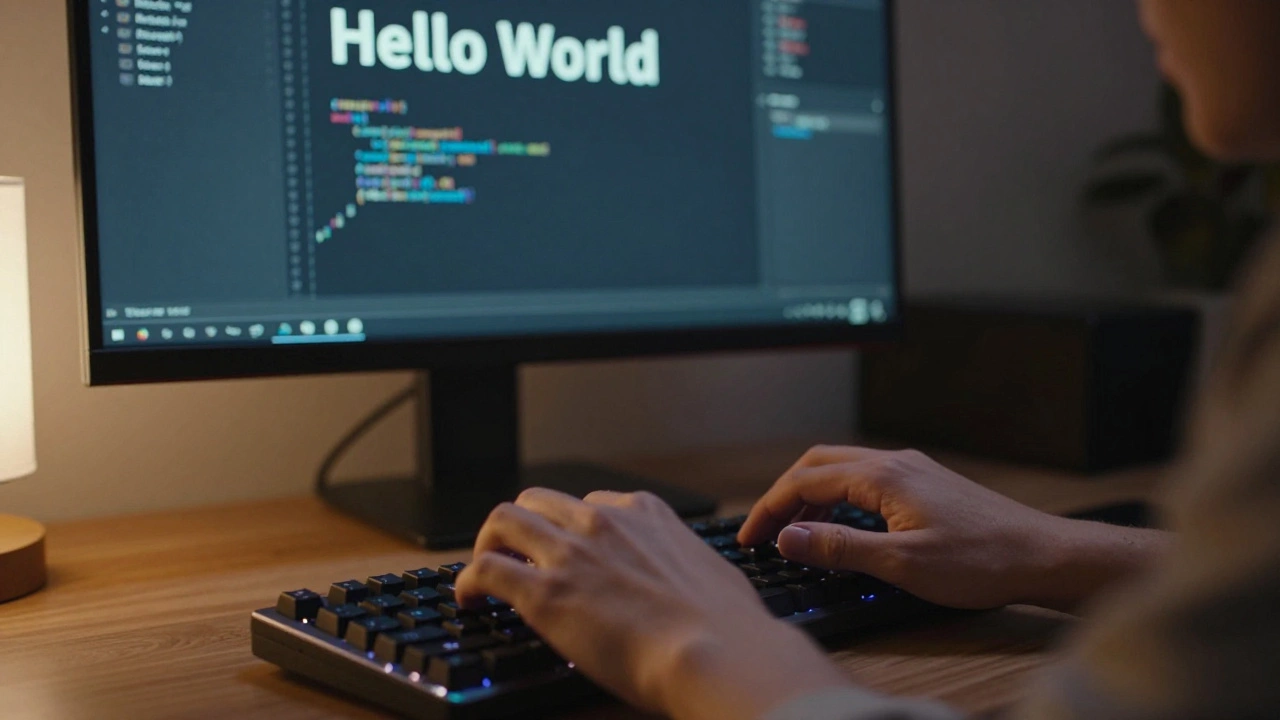
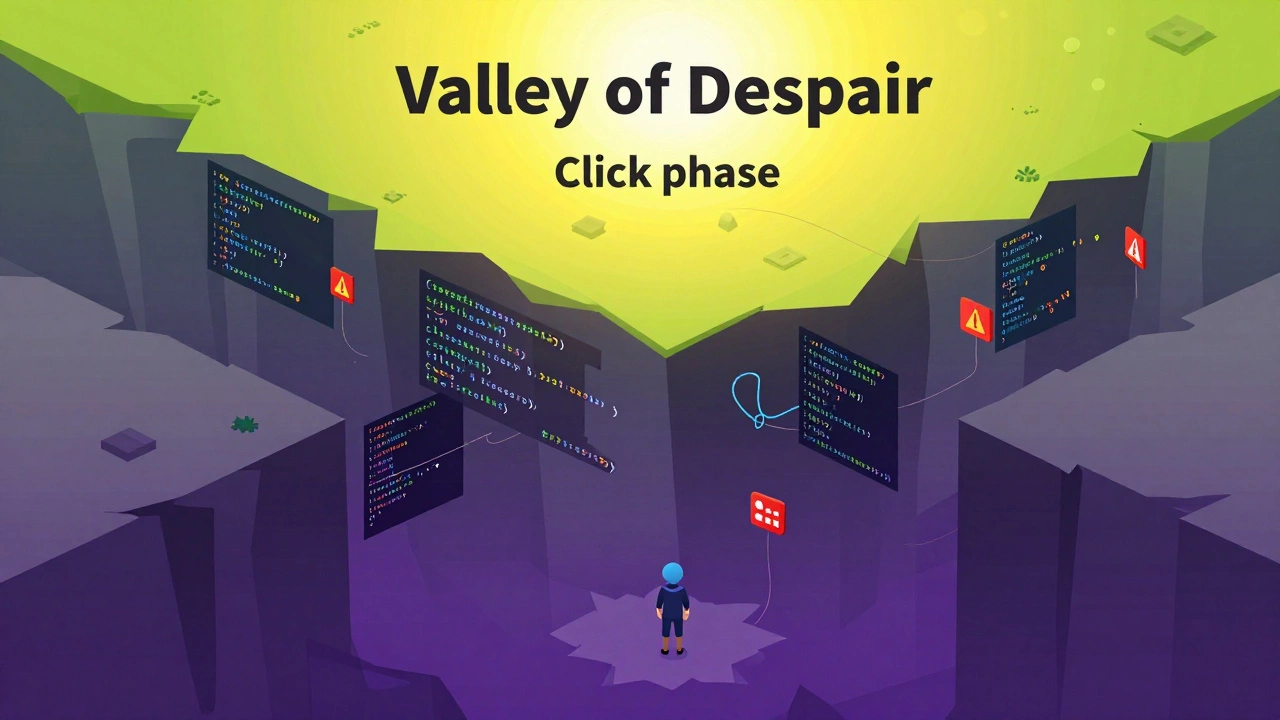
When you start, you'll likely go through three distinct phases. First is the "Honey Moon" phase, where you write your first "Hello World" and feel like a wizard. Second is the "Valley of Despair," where you try to build something simple-like a calculator-and suddenly nothing works, and you don't know why. This is where most people quit. Third is the "Click" phase, where you suddenly realize that a loop is just a way to avoid repeating yourself, and the logic starts to feel intuitive.
To get through the Valley of Despair, you need to shift your mindset. Stop trying to memorize commands. In the professional world, developers don't memorize everything; they know how to find the answer. If you spend two hours fighting a bug and then find the solution in a Stack Overflow thread, you haven't failed. You've just completed a primary part of the job: troubleshooting.
| Language | Ease of Learning | Best Use Case | Key Attribute |
|---|---|---|---|
| Python | Very Easy | Data Science / AI | Readability |
| JavaScript | Moderate | Web Development | Browser Native |
| Ruby | Easy | Rapid Prototyping | Human-friendly syntax |
| Swift | Moderate | iOS Apps | Modern & Safe |
The Secret Sauce: Logic Over Syntax
A common mistake is focusing on the language rather than the logic. Whether you use Python or JavaScript, the underlying concepts are the same. You're dealing with variables (containers for data), conditionals (if this happens, do that), and loops (do this until something changes). If you understand these, switching languages is as easy as switching from a Ford to a Toyota-the buttons are in different places, but the steering wheel does the same thing.
Think about how you organize your day. "If it's raining, I'll take an umbrella; otherwise, I'll walk." That is a conditional statement. "While there is coffee in the pot, keep pouring." That's a while-loop. You're already thinking like a programmer; you just haven't learned the specific vocabulary to tell a machine to do it.
Choosing Your Path: Self-Taught vs. Coding Classes
This is where most beginners get stuck. Should you spend six months on YouTube or invest in professional Coding Classes? Self-teaching is free and flexible, but it's easy to get lost in "tutorial hell," where you can follow a video perfectly but can't write a single line of code on a blank screen.
Structured classes provide a roadmap. They force you to build projects you wouldn't choose on your own, which is where the real growth happens. A good mentor can spot a logic error in seconds that might take you three days to find alone. However, the best results usually come from a hybrid approach: use a class for the structure, but spend your weekends building weird, useless things just for fun. Try making a program that tells you what to eat for dinner based on your mood. Those "useless" projects are where the concepts actually stick.

Common Pitfalls to Avoid
The biggest trap for beginners is the "Perfect Course" hunt. You spend three weeks researching the best course on Coursera or Udemy instead of actually coding. The truth is, the specific course matters far less than the act of typing. You cannot learn to code by watching videos; you learn by breaking things and then fixing them.
Another pitfall is avoiding the documentation. It's tempting to just copy a snippet of code from a forum, but reading the official language documentation is how you move from a "copy-paster" to a programmer. It feels like reading a dictionary at first, but eventually, it becomes your most trusted resource.
Is it Worth the Struggle?
Coding is a superpower. It allows you to automate the boring parts of your job, build a business from your bedroom, or simply understand how the digital world around you actually works. The initial frustration is just the price of admission. Once you get past the first few months of confusion, you gain a level of problem-solving ability that applies to every area of your life. You stop seeing "problems" and start seeing "bugs" that can be solved with a systematic approach.
Do I need to be good at math to start coding?
Not at all. Unless you're getting into high-end 3D graphics, game engine physics, or complex data science, basic arithmetic and a bit of logic are all you need. Most of the "math" in coding is handled by the language itself or specialized libraries.
How long does it take to become proficient?
It depends on your goals. You can learn the basics of a language like Python in a few weeks. To be job-ready, most people spend 6 to 12 months of consistent study and project-building. The key is consistency-coding for 30 minutes every day is better than coding for 10 hours once a week.
Which language should I start with in 2026?
Python is still the king for beginners because it reads like English. If you're interested in websites, start with JavaScript. If you want to build apps for iPhones, go with Swift. Don't overthink it-the most important thing is to pick one and stay with it until you've built a few projects.
Can I learn to code if I'm not a "tech person"?
Absolutely. Coding is a skill, not an innate talent. Many of the best programmers come from backgrounds in art, nursing, or philosophy. Their ability to look at a problem from a different angle often makes them better at designing software.
What is the best way to practice?
Build something you actually want to use. Instead of following another generic tutorial, try to solve a real-world problem. Create a script to rename 100 photos in a folder, or a simple website for your dog's birthday. Real-world projects force you to search for solutions to unique problems, which is how learning actually happens.