NEET 2026 Score Estimator & Strategy Tool
Configure Your Preparation Profile
Your Estimated NEET Score
Personalized Strategy Recommendations
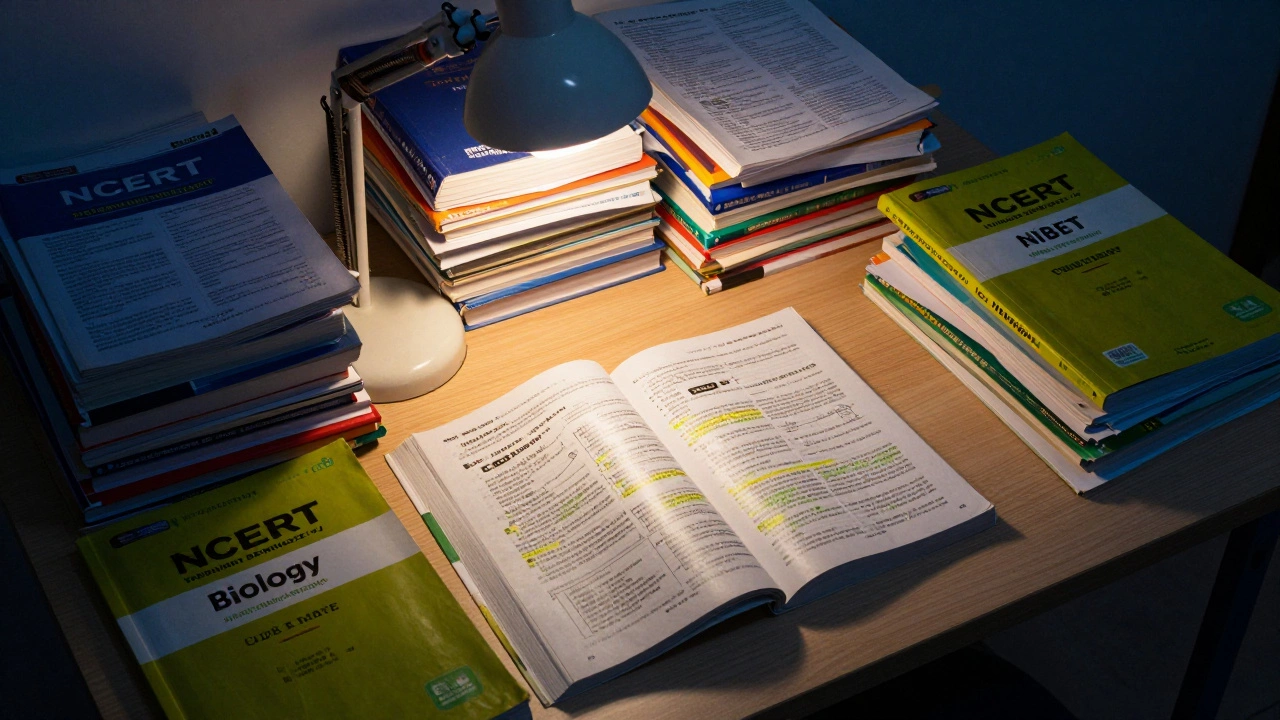
Here is the hard truth that most coaching centers won’t tell you: coaching material alone is rarely enough to crack the National Eligibility cum Entrance Test (NEET). While it provides structure and practice, relying solely on those thick modules leaves massive gaps in your understanding of the core syllabus. If you are aiming for a top rank in 2026, you need a strategy that blends coaching resources with the absolute authority of NCERT textbooks.
The Reality of NEET Syllabus and Exam Pattern
To understand why coaching material isn't sufficient, we first need to look at what NEET actually tests. The exam is designed by the National Testing Agency (NTA) based strictly on the Class 11 and 12 curricula prescribed by CBSE and other state boards. The question paper consists of 180 multiple-choice questions carrying 720 marks. You have three hours to solve these, which means you have roughly 40 seconds per question.
The distribution is straightforward:
- Physics: 45 questions, focusing on mechanics, electromagnetism, and modern physics.
- Chemistry: 45 questions, split between Physical, Organic, and Inorganic chemistry.
- Biology: 90 questions, covering Botany and Zoology from both classes.
The key here is the source of the questions. For Biology, approximately 35-40% of the questions are direct lifts from NCERT lines. For Chemistry, especially Inorganic Chemistry, the trends and exceptions listed in NCERT are law. Physics requires application, but the concepts are rooted in the same curriculum. Coaching material often expands beyond this scope, introducing complex problems that rarely appear in the actual exam, leading to wasted time and unnecessary stress.
What Coaching Material Actually Offers
Let’s give credit where it’s due. Coaching modules from institutes like Allen, Aakash, or PW are excellent for specific reasons. They condense vast amounts of information into digestible notes. They provide thousands of practice questions, ranging from easy to extremely difficult. They offer solved examples that show step-by-step problem-solving techniques, particularly useful for Physics numericals.
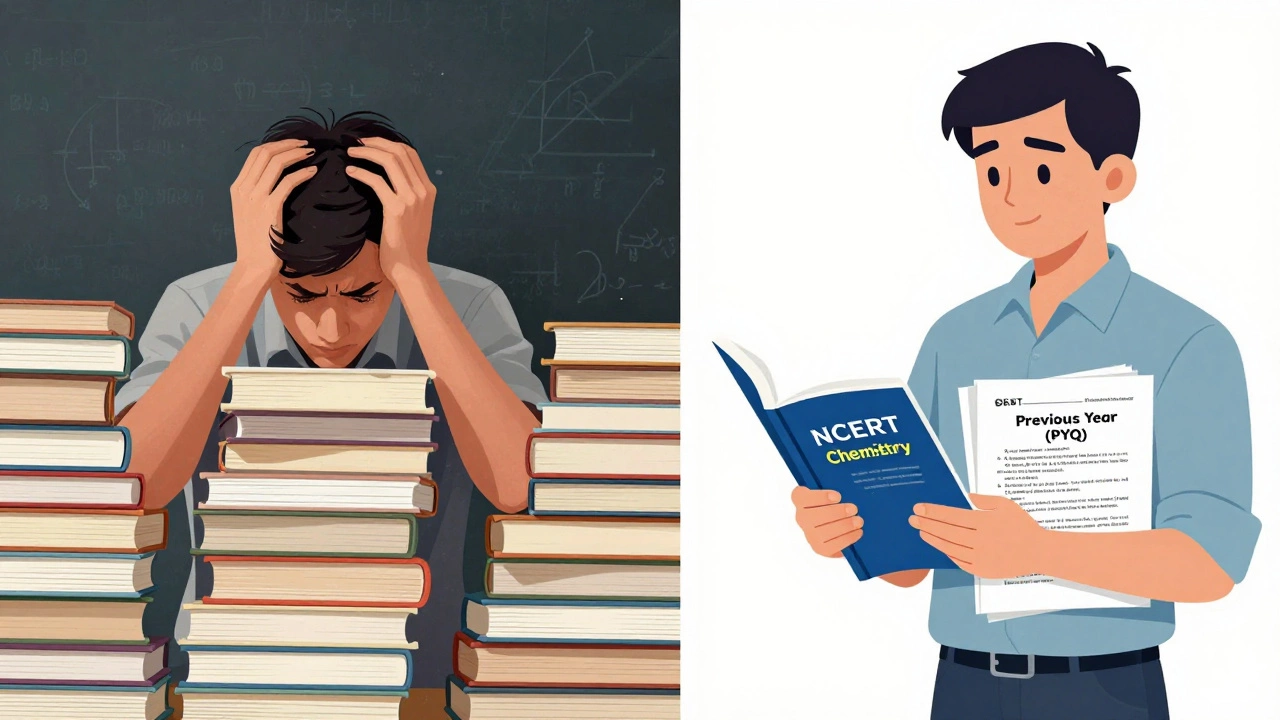
However, there is a catch. These materials are designed to sell courses and build brand authority. They often include "extra" topics or deeper theoretical derivations that go beyond the NEET syllabus. For instance, a coaching module might spend ten pages on advanced calculus applications in Physics, while the exam only tests basic integration and differentiation. This creates a false sense of security. You might feel prepared because you can solve the hardest questions in your module, but you could miss simple, direct questions from the textbook because you skimmed over them.
The Non-Negotiable Role of NCERT Books
If coaching material is the map, NCERT books are the territory. In the context of NEET, NCERT is not just a book; it is the bible. Published by the National Council of Educational Research and Training, these textbooks form the baseline for the entire exam. Ignoring them is like building a house without a foundation.
Consider Biology. Questions often ask about specific diagrams, captions, or even the exact phrasing used in the text. If a coaching note says "mitochondria is the powerhouse," but NCERT says "mitochondria produces ATP," and the question asks for the function based on the text, the NCERT definition wins. For Inorganic Chemistry, facts like the color of compounds, oxidation states, and periodic trends are verbatim from NCERT. No amount of coaching shortcuts can replace memorizing these pages line by line.
| Resource Type | Best Used For | Limitations | Weightage in Exam |
|---|---|---|---|
| NCERT Textbooks | Conceptual clarity, direct questions, theory retention | Lacks high-level practice problems | High (especially Bio & Inorganic Chem) |
| Coaching Modules | Practice speed, tricky questions, summary notes | Often exceeds syllabus, inconsistent theory | Moderate (for Physics & Organic Chem) |
| PYQs (Previous Year Questions) | Understanding exam pattern, identifying trends | Limited number of unique questions | Very High (repetition of concepts) |
Why Previous Year Questions (PYQs) Are the Missing Link
You cannot prepare for NEET without solving Previous Year Questions. PYQs act as a bridge between your study material and the actual exam. They reveal how the NTA frames questions. Do they test deep conceptual understanding or factual recall? How do they twist a standard concept to make it tricky?
Solving the last 10 years of NEET papers (including AIPMT) helps you identify recurring themes. You will notice that certain chapters, like Human Physiology or Electrostatics, appear every single year. Coaching material gives you volume, but PYQs give you direction. Without PYQs, you are studying blindly. With them, you are targeting the exam.
A Balanced Strategy for 2026 Aspirants
So, how do you combine these resources effectively? Here is a practical workflow that balances depth with efficiency.
- Start with NCERT: Read the chapter thoroughly. Highlight definitions, diagrams, and examples. For Biology and Inorganic Chemistry, treat this as your primary source. Do not skip any paragraph.
- Supplement with Coaching Notes: Use coaching material to clarify doubts and get quick summaries. If NCERT is confusing, check the coaching explanation. But do not rely on it for new information unless it clarifies an existing concept.
- Practice with Coaching Modules: Solve the exercises in your coaching modules to build speed and accuracy. Focus on Physics and Organic Chemistry here, where application matters more than rote learning.
- Test with PYQs: After finishing a chapter, solve related questions from the last 10 years. This validates your preparation. If you get stuck, go back to NCERT, not the coaching module.
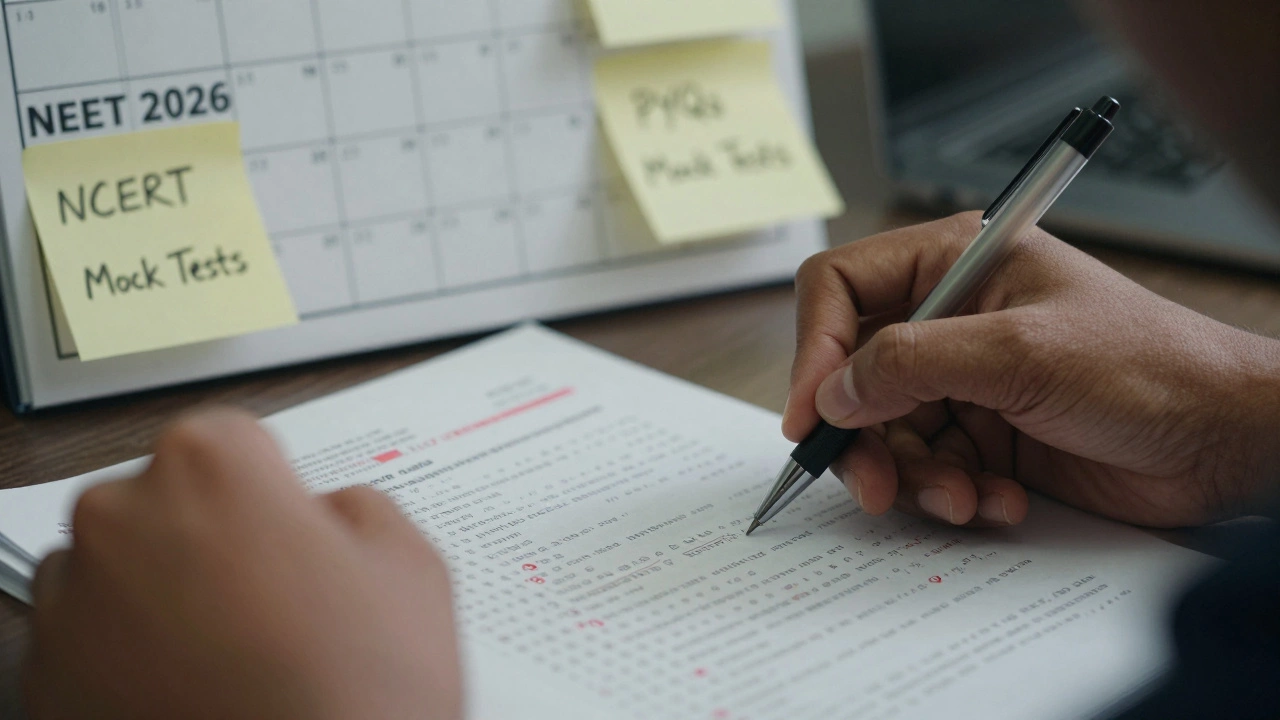
- Mock Tests: Take full-length mock tests weekly. Analyze your errors. Were they due to lack of knowledge (go back to NCERT) or lack of practice (go back to modules)?
Common Pitfalls to Avoid
Many students fall into the trap of collecting too many resources. They buy five different reference books, subscribe to two online platforms, and join a local coaching center. This leads to resource fatigue. You end up reading everything but mastering nothing.
Stick to one set of coaching material and the NCERT books. Add PYQs as your third pillar. Anything else is distraction. Another common mistake is neglecting Biology until the last month. Since it carries double the weightage of Physics and Chemistry, it should be studied daily. Reading NCERT Biology once a week is not enough; read it daily, even if just for 30 minutes.
When Is Coaching Material Actually Enough?
There are scenarios where coaching material might suffice. If you are already strong in fundamentals and just need practice, coaching modules are excellent. If you are short on time and need a quick revision guide, the summary sections in coaching books are invaluable. However, for a fresh aspirant starting from scratch, or someone looking to maximize their score, ignoring NCERT is a fatal error.
Also, consider your learning style. Some students learn better from video lectures and structured notes provided by coaching institutes. Others prefer self-study with textbooks. There is no one-size-fits-all answer, but the data shows that top rankers always prioritize NCERT alongside their coaching resources.
Can I crack NEET without joining a coaching institute?
Yes, absolutely. Many top rankers are self-prepared. The key is discipline. You must stick to NCERT books, solve Previous Year Questions diligently, and take regular mock tests. Coaching provides structure, but you can create your own schedule using free online resources and library access.
Which is more important: NCERT or coaching modules for Physics?
For Physics, coaching modules are often more useful for practice because they provide varied numerical problems. However, NCERT is essential for understanding the underlying concepts and theory. Use NCERT to learn the concept and coaching modules to apply it.
How many times should I read NCERT Biology?
Aim for at least 5-7 complete revisions of NCERT Biology before the exam. The first few reads should be detailed, noting down diagrams and examples. Later revisions should be faster, focusing on retention and recalling details from memory.
Should I ignore difficult questions in coaching material?
If a question takes more than 3-4 minutes to solve during practice, mark it and move on. NEET is a speed-based exam. Master the easy and moderate questions first. Only attempt highly complex problems if you have consistently scored above 650/720 in mock tests.
Are reference books like HC Verma necessary for NEET?
HC Verma is excellent for JEE Advanced level Physics. For NEET, it is optional. If you find NCERT and coaching modules insufficient for conceptual clarity, you can use it selectively. However, do not let it distract you from completing the core syllabus multiple times.