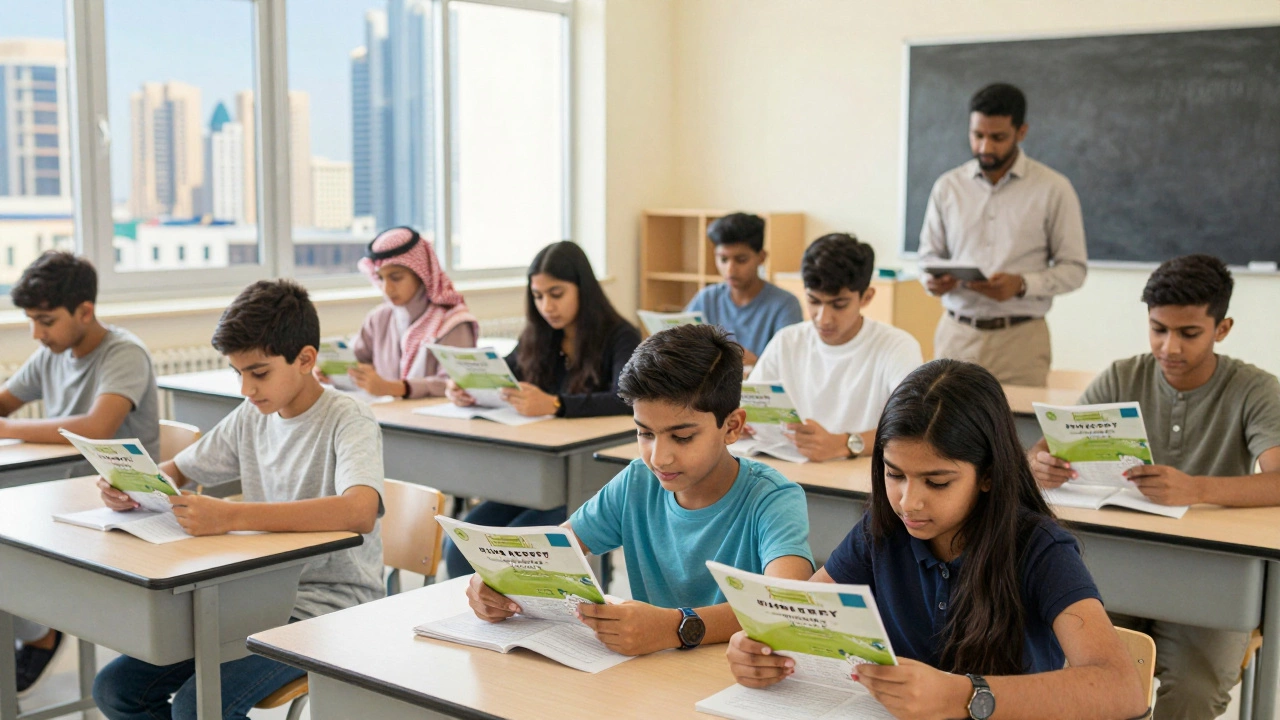
Many people assume the CBSE syllabus only exists inside India. But that’s not true. The Central Board of Secondary Education, or CBSE, runs schools in over 25 countries outside India. From Dubai to Doha, from Singapore to Sydney, you’ll find CBSE-affiliated schools teaching Indian students - and even local students - using the same textbooks, exams, and grading system as schools in Delhi or Chennai.
What Exactly Is CBSE?
CBSE stands for the Central Board of Secondary Education. It’s a national-level board in India that governs public and private schools following its curriculum. It’s not just a set of textbooks - it’s a full education system. CBSE designs syllabi for classes 1 through 12, conducts the All India Secondary School Examination (Class 10) and the All India Senior School Certificate Examination (Class 12), and sets standards for teacher training and school infrastructure.
Unlike state boards that vary wildly from one Indian state to another, CBSE offers a standardized curriculum across the country. That’s why it’s so popular among families who move often - military families, diplomats, corporate expats. The consistency means kids don’t fall behind when they switch cities.
CBSE Outside India: Where Is It Actually Found?
If you think CBSE is only in India, you’re missing a big part of the picture. The CBSE has over 200 affiliated schools in foreign countries. These are mostly run by Indian diaspora communities or international schools that chose CBSE to serve Indian-origin students.
Here are some key countries where CBSE schools operate:
- United Arab Emirates - Over 60 CBSE schools in Dubai, Abu Dhabi, and Sharjah
- Saudi Arabia - More than 40 schools, especially in Jeddah and Riyadh
- Qatar - CBSE is one of the most popular curricula for Indian expat families
- Singapore - Several Indian-run schools follow CBSE alongside the local curriculum
- United States - Schools in New Jersey, Texas, and California offer CBSE for students planning to return to India for college
- United Kingdom - A growing number of schools in London and Manchester
- Australia - CBSE schools exist in Sydney, Melbourne, and Perth, often catering to Indian families who want their children to keep up with Indian education standards
In fact, the CBSE has a dedicated Directorate of International Schools that manages these overseas institutions. They ensure these schools follow CBSE’s syllabus, use approved textbooks, and conduct exams under the same rules as schools in India.
How Do CBSE Schools Abroad Compare to Indian Schools?
They’re nearly identical. The same textbooks - NCERT books - are used. The same exam pattern: 80% final exam, 20% internal assessment. The same passing criteria. Even the same question papers are sometimes printed and shipped from India for overseas exams.
One difference? The timing of exams. While schools in India take the Class 10 and Class 12 board exams in February-March, overseas CBSE schools often schedule exams a few weeks later to accommodate local holidays and time zones. But the content? Identical.
Students in Dubai or Sydney sit for the same math paper as students in Lucknow. They study the same chapters in science. They prepare for the same competitive exams like JEE and NEET - which are still taken from abroad by many.

Who Attends CBSE Schools Outside India?
Mostly, it’s children of Indian expatriates - engineers, doctors, IT professionals, diplomats. But increasingly, non-Indian students are enrolling too.
Why? Because CBSE is seen as rigorous, especially in math and science. It’s a strong foundation if you plan to enter Indian universities later. It’s also more affordable than IB or Cambridge curricula in many countries.
Take a school in Sydney: it might have 70% Indian students, 20% Australian students of Indian heritage, and 10% from other South Asian countries. All of them learn the same biology chapter on human reproduction, the same chemistry on chemical bonding, the same English literature from Indian authors like Rabindranath Tagore.
Is CBSE Accepted Worldwide?
Yes - but with conditions. CBSE Class 12 certificates are recognized by universities in the UK, USA, Canada, Australia, and many European countries. But universities don’t automatically accept CBSE scores the same way they do IB or A-Levels.
For example:
- USA: CBSE students need to submit scores along with SAT/ACT and sometimes AP exams. Many top universities like UCLA and NYU accept CBSE.
- UK: UCAS points are assigned based on CBSE results. A score of 80%+ in five subjects is often equivalent to A-Levels.
- Australia: Universities like the University of Melbourne and UNSW accept CBSE Class 12 scores directly for undergraduate admissions.
- Canada: CBSE is accepted by most public universities, but some require a credential evaluation.
So while CBSE isn’t always the *preferred* curriculum abroad, it’s absolutely valid. Many students from CBSE schools in Dubai or Singapore get into Ivy League universities and top engineering schools in India.
What About the CBSE Syllabus Itself?
The CBSE syllabus is designed to be national - not local. It’s updated every few years by the NCERT (National Council of Educational Research and Training). The focus is on:
- Strong fundamentals in math and science
- Emphasis on problem-solving over rote memorization
- Integration of digital literacy and environmental education
- Focus on Hindi and English as core languages
For students outside India, this means they’re learning the same content as their peers back home. A student in London studying Class 9 Physics will cover the same topics - Newton’s laws, motion, sound - as a student in Jaipur.
That’s why CBSE is so popular among families who plan to return to India. It keeps kids on track for JEE, NEET, and other competitive exams - even if they’re living in another country.
Can Non-Indian Students Join CBSE Schools?
Yes. There’s no rule saying only Indian citizens can enroll. Many international schools choose CBSE because it’s affordable, well-structured, and has strong academic outcomes. In countries like Oman or Kenya, you’ll find schools where most students are local, but they follow CBSE because it gives them a clear path to Indian universities.
One school in Nairobi, for example, has 120 students - only 15 are Indian. The rest are Kenyan, Ugandan, and Tanzanian. But they all take the same CBSE Class 10 exam. Their certificates say "Central Board of Secondary Education, India" - and they’re accepted by universities in India and abroad.
Why Does CBSE Have a Global Presence?
It’s simple: demand. With over 10 million Indians living abroad - and millions more from neighboring countries like Nepal, Bangladesh, and Sri Lanka - there’s a huge market for an affordable, high-quality curriculum that connects students to Indian higher education.
CBSE fills that gap. It’s not trying to compete with IB or Cambridge. It’s offering something different: a reliable, structured, and affordable system that works for families who value Indian education standards - no matter where they live.
Final Thoughts
So, is CBSE only in India? No. It’s a global education system with a strong Indian core. Whether you’re in Mumbai or Melbourne, the CBSE syllabus stays the same. The exams are the same. The textbooks are the same. And for families who want their children to keep ties with India’s education system - even while living abroad - CBSE is one of the most practical choices out there.
If you’re considering an international school and want your child to stay on track for Indian universities, CBSE is a solid option - no matter where you are in the world.
Is the CBSE syllabus the same in India and abroad?
Yes. CBSE schools outside India follow the exact same syllabus, use the same NCERT textbooks, and conduct exams under the same guidelines as schools in India. The only differences might be minor adjustments in exam dates to suit local holidays or time zones.
Can students from CBSE schools abroad apply to Indian universities?
Absolutely. Indian universities like IITs, NITs, AIIMS, and DU accept CBSE Class 12 certificates from overseas schools. Students must submit their mark sheets and pass the required entrance exams (like JEE, NEET, CUET), just like students in India.
Are CBSE schools abroad more expensive than local schools?
Usually not. CBSE schools are often more affordable than IB or Cambridge schools. In countries like the UAE or Australia, CBSE fees can be 30-50% lower than international curricula, making them popular among middle-income expat families.
Do CBSE schools abroad teach Hindi?
Yes, Hindi is part of the curriculum unless the student opts for a regional language. Many overseas CBSE schools offer Hindi as a second language, especially for students with Indian heritage. Some schools also offer Sanskrit.
Can I take JEE or NEET from abroad if I study CBSE?
Yes. CBSE students living abroad can register for JEE (Main) and NEET through the official websites. The exams are held in multiple international cities including Dubai, Singapore, and Kuwait. You just need to meet the eligibility criteria and apply online.