
NEET Score Predictor & Strategy Analyzer
Input Your Performance Metrics
Your Results
Input your metrics above to receive personalized recommendations based on current NEET patterns.
Every year, over two million students sit for the NEET (National Eligibility cum Entrance Test), hoping to secure a seat in India’s top medical colleges. The competition is fierce, and simply reading textbooks isn’t enough anymore. You need a strategy that turns knowledge into speed, accuracy, and confidence. If you are asking yourself how to practice effectively, you are already ahead of those who just hope for luck.
The truth is, many students spend hours studying but fail to score above 130 because they practice the wrong way. They solve random questions without understanding patterns or analyzing their mistakes. In this guide, we will break down exactly how to structure your daily practice, which resources matter most, and how to simulate exam conditions so you can walk into the NTA exam center with zero anxiety.
Your Foundation: Mastering NCERT Before Anything Else
Before you touch a single question bank from external authors, you must master the NCERT textbooks. For Biology, these books are not just reference material; they are the bible. Nearly 90% of Biology questions in NEET are directly derived from NCERT lines, diagrams, and examples. If you skip this step, you are building a house on sand.
Here is how to practice with NCERT:
- Read actively, not passively: Do not just read through the text like a novel. Highlight key definitions, underline exceptions, and write marginal notes for complex processes like photosynthesis or human reproduction.
- Memorize the language: Medical entrance exams often use specific terminology found only in NCERT. If the book says "mitochondria is the powerhouse," do not write "energy generator" in your answer sheet during conceptual clarity checks. Stick to the source.
- Solve Intext Questions: Every chapter has questions embedded within it. Solve them immediately after reading the section. These are often low-hanging fruit in the actual exam.
For Physics and Chemistry, NCERT provides the theoretical foundation. However, you will need to supplement this with standard reference books like HC Verma for Physics and OP Tandon for Chemistry to handle numerical problems. But always return to NCERT for Organic Chemistry mechanisms and Inorganic facts.
The Art of Solving Previous Year Questions (PYQs)
Solving previous years’ papers is the single most effective way to understand the pattern of the NTA (National Testing Agency). It tells you what the examiners value. Don’t just solve them once; dissect them.
Start by solving PYQs from the last 10 years. Analyze them subject-wise first. For example, solve all Physics questions from 2015-2025 together. This helps you identify recurring topics. You might notice that Rotational Mechanics or Electrostatics appear every single year. Mark these as high-priority areas.
When practicing PYQs, focus on these three metrics:
- Time per question: Aim for 45-60 seconds per question initially. As you improve, try to reduce this to 30 seconds for straightforward concepts.
- Accuracy rate: Track how many questions you get right out of 10. If your accuracy is below 70%, stop taking more tests and go back to concept revision.
- Negative marking awareness: NEET penalizes you for wrong answers. Learn to identify questions you don’t know rather than guessing blindly. Practice skipping questions strategically.
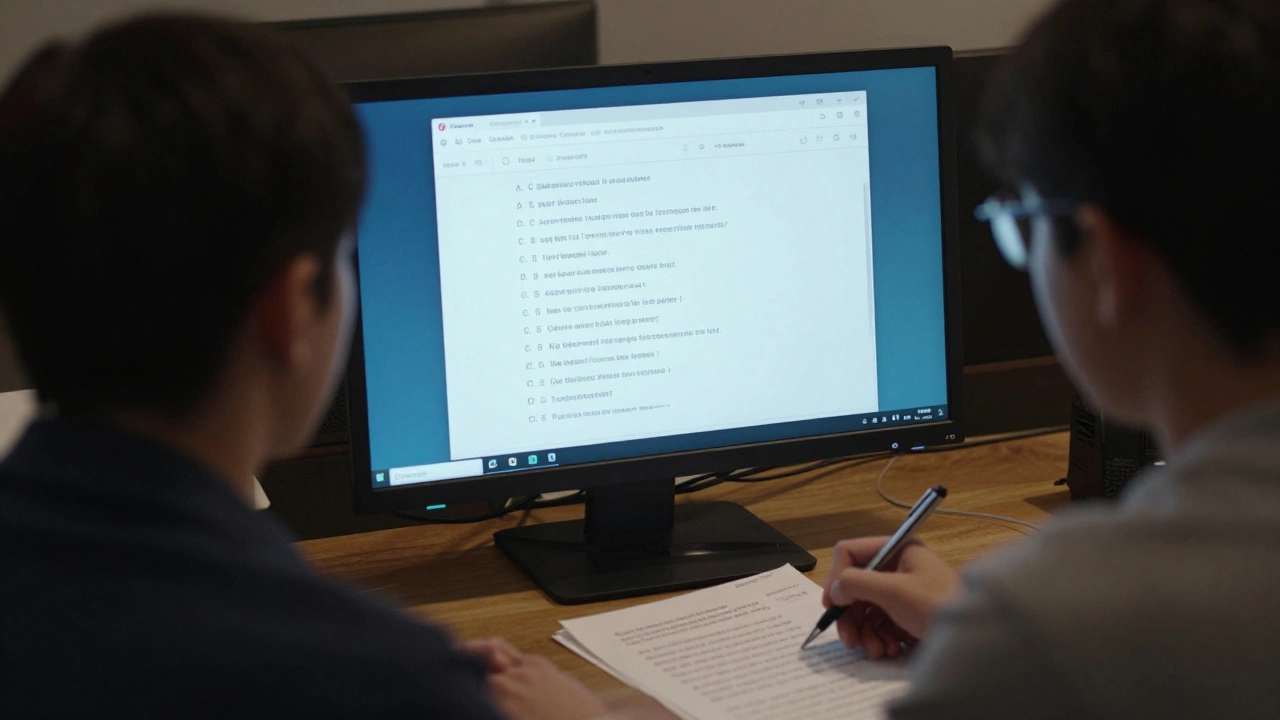
Mock Tests: Simulating the Real Exam Environment
Many students take mock tests casually-lying on their bed, pausing when stuck, or checking answers halfway through. This is a mistake. To practice for NEET, you must simulate the actual exam conditions rigorously.
Take at least one full-length mock test every week during your final six months of preparation. Use platforms like Allen, Aakash, or FIITJEE test series, which are known for their difficulty levels comparable to or higher than the actual NEET.
Follow this strict protocol for every mock test:
- Fixed timing: Sit between 2 PM and 5:20 PM, the same slot as the actual NEET exam. Your brain needs to adapt to performing under fatigue during these hours.
- No distractions: Turn off your phone, close other tabs, and ensure a quiet environment. Treat it like the real thing.
- Computer-Based Test (CBT) interface: Since NEET is now conducted online, practice using a computer interface. Get comfortable with the navigation buttons, the mark-for-review feature, and the on-screen calculator.
After each test, spend double the time analyzing your performance compared to the time spent taking the test. Create an error log. Categorize your mistakes into three types: silly errors, conceptual gaps, and time management issues. Address each category differently.
Subject-Wise Practice Strategies
Each subject in NEET requires a different approach to practice. Here is how to tailor your method for Physics, Chemistry, and Biology.
| Subject | Primary Focus | Practice Method | Key Resource |
|---|---|---|---|
| Biology | Memory & Detail | Flashcards, Diagram labeling, NCERT line-by-line revision | NCERT Class 11 & 12 |
| Physics | Concept Application | Solving numericals, Deriving formulas, Shortcuts | HC Verma, DC Pandey |
| Chemistry | Reaction Mechanisms & Facts | Writing reactions, Memorizing trends, Solving numericals | OP Tandon, MS Chouhan |
Biology: This is your scoring engine. Practice by writing short notes for each chapter. Try to explain complex topics like Genetics or Ecology aloud to yourself. If you can teach it, you know it. Focus heavily on diagrams; label them repeatedly until you can draw them from memory.
Physics: Don’t just read solutions. Write down every step. Understand why formula A applies here and not formula B. Practice dimensional analysis to quickly eliminate wrong options in multiple-choice questions. Work on speed by learning shortcut tricks for common problems like kinematics or current electricity.
Chemistry: Split your practice into Physical, Organic, and Inorganic. For Physical Chemistry, practice numericals daily to keep calculation skills sharp. For Organic, focus on reaction mechanisms and name reactions. For Inorganic, create charts for periodic trends, coordination compounds, and p-block elements. Repetition is key here.

The Power of Revision and Spaced Repetition
Practicing without revision is futile. You might solve a problem today, but if you don’t revisit it, you will forget the concept in two weeks. Implement a spaced repetition system.
Use a simple calendar-based revision schedule:
- Day 1: Learn the topic and solve basic questions.
- Day 3: Revise notes and solve medium-level questions.
- Day 7: Re-solve difficult questions from Day 1.
- Day 21: Quick review of formulas and key facts.
- Day 45: Final comprehensive review before mocks.
This method ensures that information moves from short-term to long-term memory. Keep a separate notebook for "One-Liners"-quick facts, formulas, and exceptions that are easy to forget. Review this notebook every morning for 15 minutes.
Managing Time and Mental Health
NEET preparation is a marathon, not a sprint. Burning out is a real risk. Practice self-care as diligently as you practice Biology. Sleep for at least 7 hours a night. A tired brain makes more mistakes and retains less information.
Incorporate physical activity into your routine. Even a 20-minute walk can boost cognitive function. Avoid comparing your progress with others. Social media often shows highlight reels of toppers, creating unnecessary pressure. Focus on your own improvement curve.
If you feel overwhelmed, take a half-day break once a month. Use this time to disconnect completely from studies. This mental reset prevents burnout and keeps your motivation high for the long haul.
How many hours should I study for NEET daily?
Most successful candidates study between 8 to 10 hours a day, including breaks. However, quality matters more than quantity. Ensure that at least 6 of these hours are focused, distraction-free study time. Include 2-3 hours specifically for solving questions and revising, not just reading.
Is it enough to only study NCERT for NEET?
For Biology, NCERT is nearly sufficient if you master it completely. However, for Physics and Chemistry, you need additional reference books to practice numerical problems and understand deeper concepts. NCERT alone will not provide enough exposure to the variety of questions asked in NEET.
When should I start taking mock tests?
You should start taking sectional mock tests (subject-wise) after completing the syllabus for that subject. Full-length mock tests should begin at least 6 months before the exam date. This gives you enough time to analyze weaknesses and improve your speed and accuracy.
What is the best strategy for negative marking in NEET?
Never guess unless you can eliminate at least two options. If you are unsure between two choices, rely on your intuition but be cautious. Prioritize accuracy over attempting all questions. It is better to leave a question blank than to lose marks due to a wrong answer.
Can I crack NEET in one year?
Yes, it is possible to crack NEET in one year with intense dedication and a structured plan. Focus on high-weightage chapters, master NCERT, and solve PYQs consistently. Consistency and smart work are more important than the duration of preparation.