
Personal English Speaking Routine Builder
Step 1: Choose Your Practice Methods
Select the techniques you want to include in your routine.
Shadowing
Imitate native speakers' speed and intonation.
Self-Narration
Talk to yourself about your daily activities.
Language Exchange
Real conversation with partners via apps.
Podcast Listening
Active listening to train your ear.
Step 2: Set Your Commitment
Ever opened your mouth to say something in English and felt like your brain just hit a wall? You know the word. You know the grammar rule. But when it’s time to speak, silence wins. If this sounds familiar, you are not alone. Millions of learners struggle with the gap between understanding English and actually speaking it.
The good news is that speaking fluency isn’t a talent you’re born with. It’s a skill you build, brick by brick. Whether you are preparing for an interview, traveling abroad, or just want to chat confidently with friends, improving your English speaking skills requires a shift in how you practice. It’s less about memorizing dictionaries and more about training your mouth, your ears, and your confidence.
Rewire Your Brain for Sound Production
Most of us learn English through reading and writing. We see words on a page, process them visually, and understand their meaning. But speaking is a physical act. It involves muscles in your tongue, lips, and jaw moving in patterns that might feel foreign to you. If you treat speaking like a math problem to be solved rather than a muscle to be trained, you will stay stuck.
To bridge this gap, you need to engage in active output. Passive listening helps, but it won’t make you fluent. You have to produce the sounds yourself. Start by focusing on phonetics-the actual sounds of the language. English has sounds that don’t exist in many other languages, like the 'th' in "think" or the vowel sound in "butter." Practice these specific sounds daily. Record yourself saying difficult words and compare them to native speakers. This feedback loop helps your brain recognize what correct pronunciation looks and sounds like.
Another powerful technique is shadowing. Find a short audio clip of a native speaker-maybe a podcast snippet or a YouTube video-and repeat exactly what they say, mimicking their speed, intonation, and emotion. Do this until you can match them closely. This trains your mouth muscles to move automatically, reducing the mental effort required to form words later.
Create a Safe Space to Make Mistakes
Fear is the biggest killer of fluency. Many learners freeze up because they are terrified of making grammatical errors or sounding silly. Here is the truth: mistakes are data. Every error you make tells you exactly what you need to fix next. If you never make mistakes, you aren’t pushing hard enough.
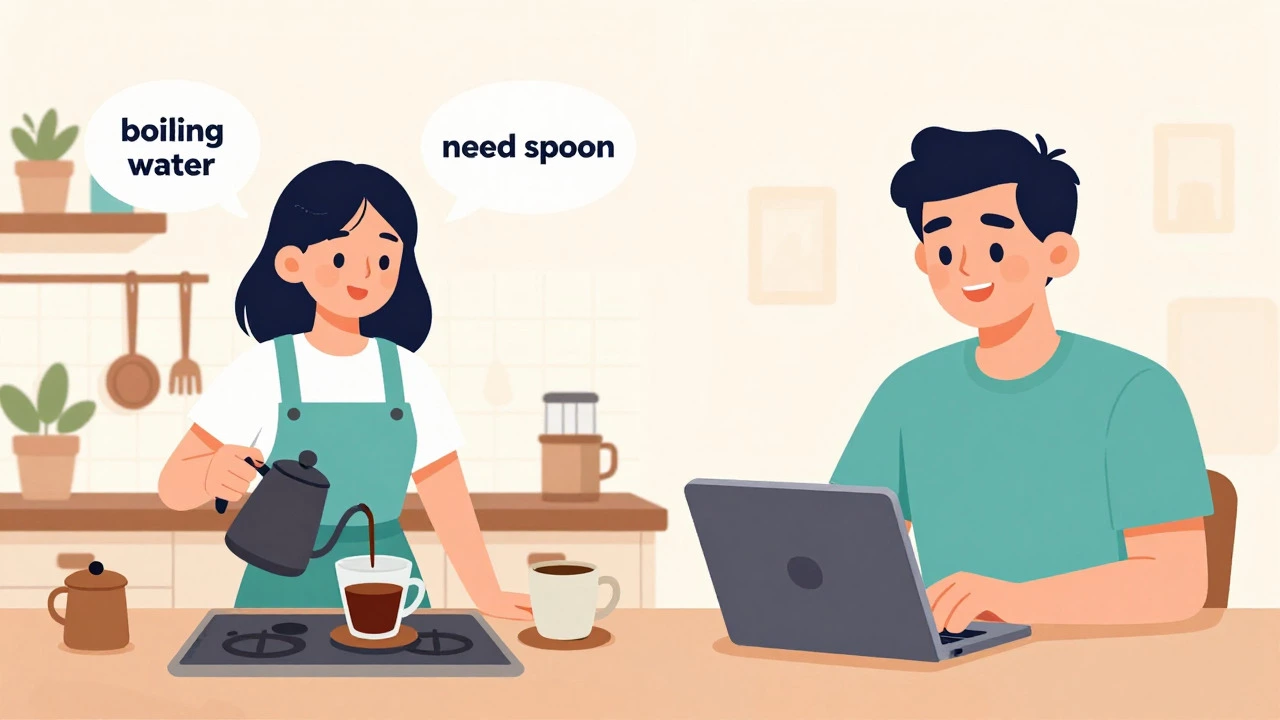
To lower the stakes, start practicing in low-pressure environments. Talk to yourself. Yes, really. Narrate your day as you go about it. "I am making coffee now. The water is boiling. I need a spoon." This might feel awkward at first, but it builds the habit of thinking in English without the pressure of another person judging you. It also helps you identify vocabulary gaps. When you can’t find the word for "kettle," you look it up immediately, which reinforces memory.
If talking to yourself feels too strange, try using language exchange apps. Platforms like HelloTalk or Tandem connect you with people who want to learn your native language in exchange for helping you with English. These interactions are usually casual and friendly. People appreciate the effort, even if your grammar isn’t perfect. The goal here is communication, not perfection. Focus on getting your point across. If someone understands you, you succeeded.
Expand Your Vocabulary Through Context
You don’t need to know every word in the dictionary to speak well. In fact, trying to memorize long lists of isolated words is inefficient. Instead, focus on high-frequency phrases and collocations-words that naturally go together. For example, we don’t just say "make" and "decision." We say "make a decision." We don’t say "do a mistake." We say "make a mistake."
Learn words in chunks. When you read an article or watch a movie, pay attention to how words are grouped. Note down entire phrases, not single words. This helps you retrieve information faster during conversation. When you are speaking, your brain doesn’t have time to construct sentences from scratch. It pulls pre-built blocks from memory. The more blocks you have, the smoother your speech will be.
Also, prioritize useful vocabulary over obscure terms. Knowing how to discuss your job, hobbies, opinions, and daily life is far more valuable than knowing scientific terminology unless that’s your field. Build a personal vocabulary journal. Write down new phrases you encounter and use them in sentences right away. Review this journal weekly. Consistency beats intensity here. Ten minutes a day is better than two hours once a month.

Listen Actively to Train Your Ear
Speaking and listening are two sides of the same coin. If you can’t hear the subtle differences in sounds, you can’t reproduce them. Active listening means engaging with the content, not just having it play in the background. Choose materials that interest you. If you love cooking, watch English-language cooking shows. If you are into tech, listen to podcasts about software development.
Diversify your input sources. Listen to different accents. American, British, Australian, Indian-exposing yourself to variety makes you a more adaptable speaker. It also helps you understand real-world conversations where people mumble, interrupt, or use slang. Movies and TV series are great for this. Watch with subtitles at first, then try without them. Pause and repeat lines to practice intonation.
Podcasts are particularly effective because they often feature natural dialogue. Look for shows designed for learners, such as "6 Minute English" by BBC Learning English, which breaks down topics into manageable segments. As you improve, transition to native-level content. The key is to listen critically. Ask yourself: What was the main point? How did the speaker express agreement or disagreement? What idioms did they use?
Build Confidence Through Routine
Fluency comes from repetition. You need to create a routine that keeps English in your daily life. Set aside specific times for practice. Maybe you spend ten minutes before breakfast shadowing a podcast. Or perhaps you join an online speaking club every Tuesday evening. Consistency creates momentum.
Track your progress. Record yourself speaking on the same topic each month. Compare the recordings. You might not notice improvement day-to-day, but looking back at old recordings reveals how much you’ve grown. Celebrate small wins. Did you finish a sentence without stopping? Did you use a new phrase correctly? Acknowledge these victories.
Finally, surround yourself with English. Change your phone’s language setting. Follow English-speaking influencers on social media. Read news articles in English. Immerse yourself in the language as much as possible. The more exposure you get, the more natural it becomes. Remember, fluency is a journey, not a destination. Keep showing up, keep speaking, and keep making mistakes. That’s how you get better.
| Method | Best For | Time Commitment | Difficulty Level |
|---|---|---|---|
| Shadowing | Pronunciation & Intonation | 10-15 mins/day | Medium |
| Self-Narration | Vocabulary Recall | 5-10 mins/day | Easy |
| Language Exchange | Real Conversation | 30-60 mins/week | Hard |
| Podcast Listening | Listening Comprehension | 20-30 mins/day | Variable |
How long does it take to become fluent in English?
There is no fixed timeline, as it depends on your current level, study habits, and exposure. However, consistent daily practice of 30-60 minutes can lead to noticeable improvement within 3-6 months. Fluency is a gradual process, so focus on steady progress rather than a specific deadline.
Is it better to study grammar or just speak?
Both are important, but balance is key. Too much grammar study without speaking leads to paralysis by analysis. Too much speaking without grammar awareness can fossilize errors. Aim for 70% active speaking/listening practice and 30% structured grammar review.
What should I do if I forget words while speaking?
Don’t stop. Use circumlocution-describe the word you can’t remember. For example, if you forget "umbrella," say "the thing you hold over your head in rain." This keeps the conversation flowing and builds flexibility. Later, look up the correct word.
Can I improve my accent without formal classes?
Yes. Shadowing native speakers, recording yourself, and using pronunciation apps like ELSA Speak can significantly improve your accent. Focus on clarity and intelligibility rather than achieving a perfect native-like accent, which is often unnecessary.
How can I overcome fear of speaking English?
Start with low-stakes practice like talking to yourself or using language exchange apps. Remind yourself that mistakes are part of learning. Most listeners care about your message, not your grammar. Gradually expose yourself to more challenging speaking situations as your confidence grows.