
Career Pivot Strategy Tool
How it works: Select your current professional background and the technical interest that appeals to you. We'll generate a "Skill Stacking" strategy to help you pivot efficiently.
Your Personalized Pivot Path
Select your options and click the button to see your strategy.
You've probably noticed that the job market doesn't look like it did five years ago. If you're staring at a LinkedIn feed full of "hiring" posts but aren't sure which ones actually lead to stability and growth, you're not alone. The reality is that while some traditional roles are shrinking, others are exploding because of how we've integrated AI and sustainable tech into every single business process. You don't need a four-year degree to enter these fields anymore; you need a portfolio of skills that actually solve problems.
Quick Takeaways: Where the Jobs Are
- AI Implementation: Companies aren't just building AI; they're desperate for people who know how to use it to automate boring tasks.
- Green Energy: The shift to renewables is creating a massive gap in specialized technical roles.
- Healthcare Tech: Aging populations and digital health records mean a huge need for "hybrid" healthcare professionals.
- Cybersecurity: As long as hackers exist, this is the most recession-proof field on the list.
The AI Integration Wave
When people talk about AI, they usually think of engineers building the models. But the real hiring surge is happening in AI Implementation. Businesses are currently struggling to figure out how to take a tool like Large Language Models AI systems trained on vast amounts of text to generate human-like responses and apply them to a specific workflow, like customer support or supply chain logistics.
If you can walk into a company and show them how to reduce their manual data entry by 40% using automation, you're an immediate asset. This is why online courses focusing on prompt engineering and AI orchestration are seeing a massive spike. You don't need to be a mathematician; you need to be a "translator" who understands both the business problem and the AI's capabilities.
Cybersecurity: The Digital Shield
Every single time a major company suffers a data breach, a thousand new job openings appear. Cybersecurity The practice of protecting systems, networks, and programs from digital attacks is no longer just an IT concern; it's a boardroom priority. We're seeing a huge demand for specialists in Cloud Security and Identity Access Management (IAM).
The beauty of this field is that it rewards certifications over diplomas. If you hold a CISSP Certified Information Systems Security Professional certification or a CompTIA Security+ credential, you're often more employable than someone with a general CS degree. It's a high-stakes environment, but the pay reflects that risk. Have you considered how your current skills could pivot toward securing data?
Healthcare Technology and Telehealth
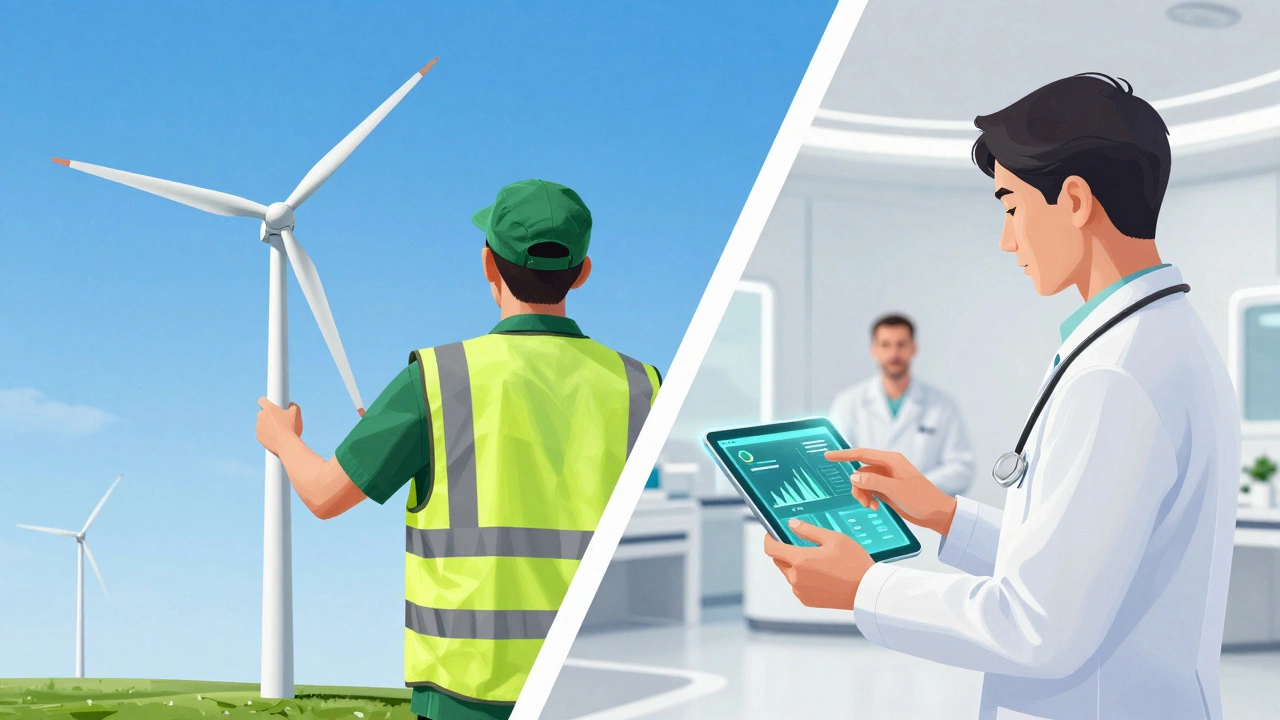
Healthcare is undergoing a digital transformation that makes the 2020s look like the early days. We are seeing a massive hiring push for Health Informatics The intersection of healthcare, information technology, and computer science. Hospitals are moving away from fragmented systems to integrated platforms that use predictive analytics to catch patient issues before they become emergencies.
Beyond the technical side, there's a huge demand for professionals who can manage telehealth platforms. These roles require a mix of patient care understanding and software proficiency. It's a unique niche where you can leverage a background in nursing or administration and boost your salary by adding a certification in healthcare data management.
| Field | Entry Barrier | Typical Learning Path | Pay Potential |
|---|---|---|---|
| AI Implementation | Medium | Online Courses & Portfolios | Very High |
| Cybersecurity | High | Industry Certifications | High |
| Green Energy Tech | Medium | Vocational Training/Degrees | Medium-High |
| Health Informatics | Medium-High | Specialized Certs/Degrees | High |

The Green Economy and Sustainability
Sustainability isn't just a buzzword anymore; it's a regulatory requirement. As governments push for net-zero emissions, there is a desperate need for people who understand Renewable Energy Energy from sources that are naturally replenished, such as sunlight, wind, and geothermal heat infrastructure. This ranges from wind turbine technicians to sustainability consultants who help corporations track their carbon footprint.
What's interesting here is the "green collar" job. These aren't all office jobs. There's a huge amount of hiring for people who can install and maintain smart grids and EV charging networks. If you're handy with tools but want to move into a future-proof industry, this is the place to be. The transition from traditional electrical work to green tech is one of the smoothest career pivots available right now.
How to Pivot Without Starting From Scratch
You don't have to go back to university for four years to change your career. The most successful pivots happen when you "stack" skills. This means taking your existing experience and adding a new, high-demand layer on top of it. For example, if you're in marketing, don't just learn "AI"-learn how to use AI for predictive consumer analytics.
Start by identifying the "skills gap" in your current role. What is the one thing your boss asks for that no one knows how to do? That's your goldmine. Once you find that gap, find a targeted course that provides a project-based certification. Employers in 2026 care less about where you learned and more about what you can actually build or fix. Can you show a case study of a problem you solved? That's your ticket to a new job.
Common Pitfalls When Changing Fields
One big mistake people make is "certification hoarding." This is when you take ten different online courses but never apply the knowledge to a real project. A recruiter doesn't want to see a list of certificates; they want to see a GitHub repository, a portfolio, or a documented success story from a freelance gig.
Another trap is ignoring "soft skills" in a technical world. As AI takes over the coding and data crunching, the ability to manage a team, communicate complex ideas to non-tech stakeholders, and exhibit empathy becomes a premium skill. The people who get hired the most are the ones who can bridge the gap between the machine and the human.
Do I need a degree to get into AI or Cybersecurity?
Not necessarily. While a degree helps, these fields are heavily focused on competency. In Cybersecurity, certifications like CISSP or Security+ are often more valued. In AI, a strong portfolio of implemented projects and specialized online courses can prove your value to an employer more effectively than a general degree.
Which field has the fastest hiring turnaround?
AI Implementation and Cloud Services currently have the fastest hiring cycles because the demand is immediate and the technology is evolving faster than universities can create curricula. Companies are hiring based on current skill sets rather than long-term academic credentials.
Are remote jobs still available in these high-growth fields?
Yes, especially in AI, Cybersecurity, and Health Informatics. However, there is a slight trend toward "hybrid" models. Roles in Renewable Energy, by nature, require more on-site presence, but the planning and management sides of that industry remain heavily remote-friendly.
What is the best way to start a career pivot?
Start by "skill stacking." Identify the most valuable technical skill that complements your existing professional experience. Take a project-based course, complete a real-world project (even if it's for a friend's business), and document the results. This creates a proof-of-concept for your new career path.
Is the Green Energy sector stable for the long term?
Extremely. Global policy shifts and climate mandates ensure that the transition to sustainable energy is a multi-decade project. This creates a long-term demand for both high-level engineers and skilled trade technicians.
Next Steps for Your Career Move
If you're feeling stuck, start by auditing your current skill set against the trends mentioned above. Don't try to learn everything at once. Pick one field-whether it's the security of data or the implementation of AI-and spend three months building a tangible project. Once you have something you can show a recruiter, the conversation shifts from "Why should I hire you?" to "How soon can you start?"