JEE Chemistry Score Estimator
See how physical chemistry affects your JEE Chemistry score. Based on data showing physical chemistry makes up 32-37% of JEE Advanced chemistry questions, this tool calculates your minimum required score to reach competitive results.
Input Your Scores
Your Chemistry Score Breakdown
Total Chemistry Score:
Physical Chemistry Contribution:
Minimum Physical Chemistry Score Needed:
Thousands of students ask this every year: Can I skip physical chemistry for JEE? It’s tempting. The formulas feel endless. The numericals are messy. You’d rather focus on organic chemistry’s reactions or math’s calculus problems. But here’s the truth-skipping physical chemistry is one of the biggest mistakes you can make in JEE Advanced preparation.
Physical Chemistry Makes Up Nearly 35% of JEE Chemistry
In JEE Main and Advanced, chemistry is split evenly between physical, organic, and inorganic. But physical chemistry isn’t just one-third-it’s the heaviest hitter. Over the last five years, JEE Advanced papers show physical chemistry consistently contributing 32-37% of the total chemistry marks. That’s 12-14 out of 40 chemistry questions. If you skip it, you’re giving away nearly a third of your chemistry score before you even start.
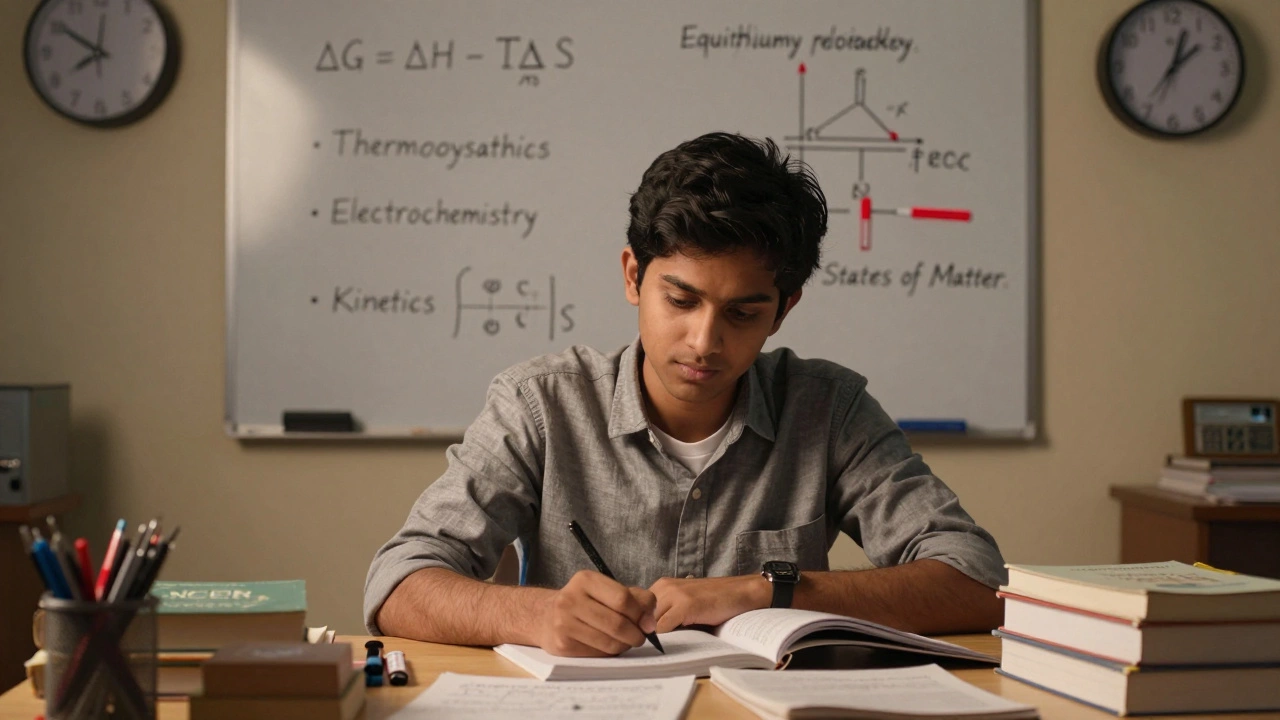
And it’s not just about quantity. Physical chemistry questions often carry higher weight. Thermodynamics, equilibrium, electrochemistry, and kinetics appear in multi-concept problems that link to other topics. Miss one concept, and you lose points across multiple questions.
Why Students Want to Skip It
It’s not laziness. It’s frustration.
Organic chemistry? You memorize reactions, draw arrows, and patterns click. Inorganic? You learn exceptions and trends-crisp, factual, repeatable. But physical chemistry? You need to think in numbers, units, graphs, and abstract ideas like entropy or activity coefficients. It doesn’t feel intuitive.
Many students think: “I’ll just memorize the formulas and guess the rest.” That works in school exams. It fails in JEE Advanced. The exam doesn’t test if you remember ΔG = ΔH - TΔS. It tests if you can use it to predict spontaneity in a reaction involving gases at non-standard pressure, then link it to equilibrium constants and then to cell potential. That’s three concepts in one question.
What Happens When You Skip It
Real student data from coaching institutes in Delhi and Kota shows a clear pattern. Students who scored below 25% in physical chemistry had a 92% chance of missing the JEE Advanced cutoff. Even if they aced organic and inorganic, their total chemistry score stayed stuck below 30/100. That’s not enough.
Take 2023’s JEE Advanced Paper 1. Question 18 combined gas laws, ideal vs real gas behavior, and van der Waals constants. Question 24 linked rate laws to half-life calculations in a radioactive decay context. These weren’t isolated problems-they were layered. You couldn’t solve them without understanding the physical chemistry foundations.
And here’s the kicker: physics and physical chemistry overlap heavily. Thermodynamics appears in both. Electrochemistry connects to current electricity. Kinetic theory of gases is tested in physics too. If you skip physical chemistry, you’re also weakening your physics score.
What You Actually Need to Master
You don’t need to become a physical chemist. But you must nail these five areas:
- Chemical Equilibrium-Kp, Kc, Le Chatelier’s principle, pH calculations, buffer systems. This shows up every year in 3-4 questions.
- Thermodynamics-First and second laws, ΔG, ΔH, ΔS, spontaneity, Hess’s law. Often tested with graphs or multi-step reactions.
- Electrochemistry-Nernst equation, cell potential, Faraday’s laws, conductivity. These are high-mark questions with clear right/wrong answers.
- Chemical Kinetics-Order of reaction, rate constants, half-life, Arrhenius equation. Often paired with graphs or experimental data.
- States of Matter-Ideal gas law, real gases, van der Waals, kinetic theory. Frequently tested with numericals on pressure, volume, temperature changes.
These five topics account for 85% of physical chemistry questions in the last five JEE Advanced papers. Master these, and you cover most of the ground.

How to Study It Without Getting Overwhelmed
Start small. Don’t try to solve 50 numericals in one day. Pick one topic-say, equilibrium-and do this:
- Watch one 15-minute video explaining Kc vs Kp (from a trusted source like NCERT or Khan Academy).
- Solve 5 basic problems-just enough to get comfortable with the math.
- Then solve 2 JEE Advanced-level problems from past papers.
- Write down the logic: “If pressure increases, the system shifts to reduce pressure-so toward fewer moles.”
Repeat this for 15 minutes a day. In 30 days, you’ll have covered all five core topics. The key isn’t volume-it’s consistency. Physical chemistry rewards daily exposure, not cramming.
Use NCERT as your base. Don’t jump to advanced books like Atkins or Physical Chemistry by OP Tandon until you’ve mastered NCERT’s examples. Most JEE questions are built on NCERT concepts, just twisted slightly.
The Bottom Line
You cannot skip physical chemistry and still expect to crack JEE Advanced. It’s not optional. It’s not a shortcut. It’s the backbone of chemistry and a major contributor to your overall rank.
Yes, it’s hard. Yes, it feels abstract. But so is quantum mechanics in physics-and you don’t skip that. You don’t skip calculus in math. So why skip physical chemistry?
Every year, hundreds of students who scored 95+ in organic chemistry still miss the cutoff because they left physical chemistry to chance. Don’t be one of them.
Start today. Pick one topic. Solve three problems. Write the logic. Repeat. In a month, you’ll look back and wonder why you ever thought about skipping it.
Is physical chemistry the most important part of JEE chemistry?
Yes, physically, it carries the highest weightage-about 35% of chemistry questions in JEE Advanced. More importantly, its concepts overlap with physics and form the foundation for understanding reaction behavior, energy changes, and equilibrium systems. Skipping it means leaving a major chunk of your score on the table.
Can I rely only on organic chemistry to score well in JEE?
No. Organic chemistry is easier to memorize, but it only makes up one-third of the chemistry section. Even if you score full marks in organic (40/40), you still need to score 15+ in physical and 10+ in inorganic to hit a competitive chemistry total. Without physical chemistry, your chemistry score will cap at 60/100, which isn’t enough for top ranks.
Which topics in physical chemistry are easiest to score in?
Electrochemistry and Chemical Equilibrium are the most predictable. Nernst equation, cell potential, pH of buffers, and Kp/Kc calculations follow clear patterns. These topics rarely involve complex derivations and often appear as direct numerical problems. Master these first-they give you the quickest return on study time.
How many hours should I spend on physical chemistry daily?
15-25 minutes a day is enough if you’re consistent. Focus on one topic per day. Solve 3-5 problems, write down the reasoning, and review mistakes. Over 30 days, that’s 7-10 hours total-less than one full day of cramming, but far more effective. Quality beats quantity.
Should I use advanced books like Atkins for JEE physical chemistry?
No, not initially. Atkins and other university-level books are too theoretical for JEE. Stick to NCERT for concepts and past JEE papers for practice. Once you’ve solved all JEE-level problems from 2018-2025 and understand the pattern, you can use books like OP Tandon or RC Mukherjee for extra numericals. But never start with advanced texts.