Curriculum Fit Finder
Every parent eventually faces the same stressful question: which school system will give my child the best future? If you are living in India or considering moving there from abroad, the choice usually boils down to two giants-the CBSE is the Central Board of Secondary Education, the national board that follows a standardized Indian curriculum focused on science and mathematics. On the other side, you have the British curriculum, often delivered through international schools offering IGCSEs and A-Levels. There is no single "better" option. The right choice depends entirely on where you plan to live, what career your child might pursue, and how they learn best.
I’ve spent years analyzing educational frameworks across Asia and Australia. From my base in Sydney, I see families constantly weighing these options. It’s not just about prestige; it’s about fit. Before we break down the differences, if you are traveling to Thailand for work or leisure while sorting out your family's logistics, you might find resources like this directory useful for navigating local services discreetly, though today we are strictly focused on academics.
The Core Philosophy: Standardization vs. Flexibility
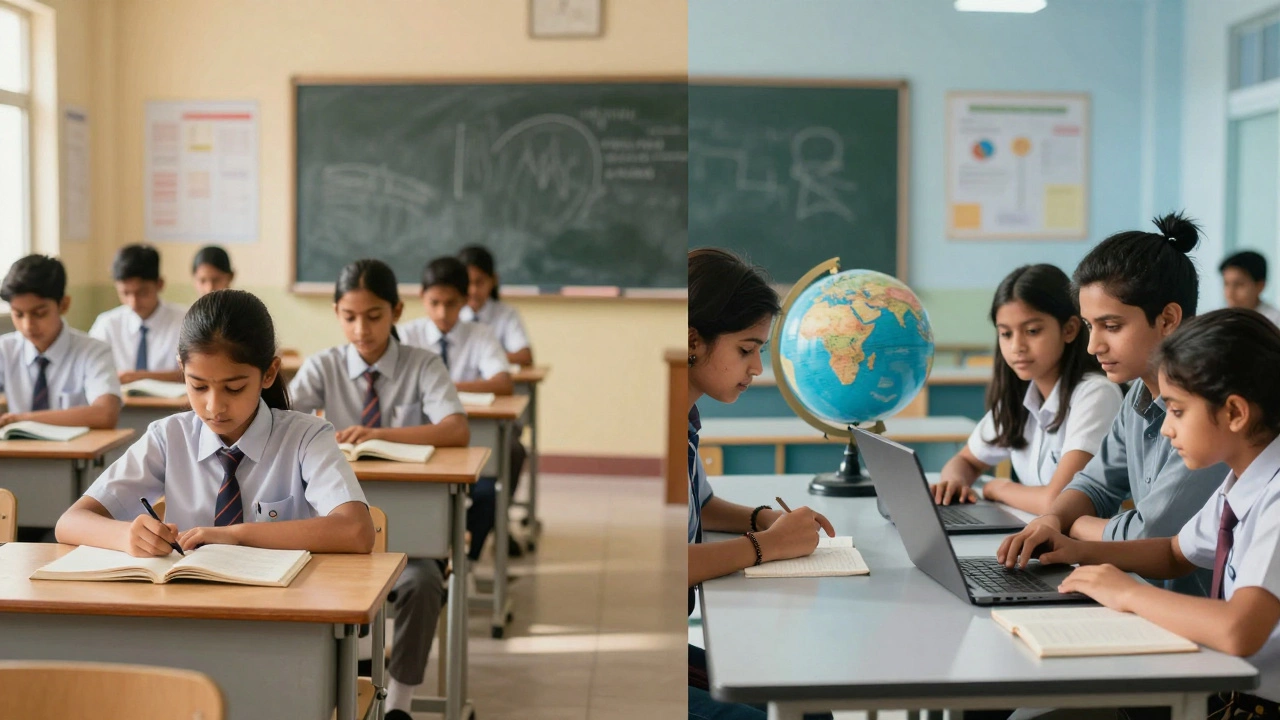
To understand which is better, you first need to understand what each system actually does. The CBSE is designed for scale and uniformity. It serves millions of students across India. The goal is to ensure that a student in Delhi has the same foundational knowledge as a student in Mumbai. This creates a very structured environment. The syllabus is fixed, the textbooks are prescribed, and the assessment methods are rigid. For many parents, this structure feels safe. You know exactly what is being taught and when.
The British curriculum, particularly the Cambridge International pathway (IGCSE and A-Levels), operates differently. It is built around flexibility and critical thinking. Instead of memorizing vast amounts of data, students are encouraged to analyze, evaluate, and construct arguments. The content is global rather than localized. A history lesson in a British-curriculum school in Gurgaon looks almost identical to one in London or Singapore. This global consistency is a huge plus if you plan to move countries frequently.
Curriculum Structure and Subject Choice
Let’s look at the day-to-day reality for the student. In the CBSE system, the curriculum is broad until Class 10. Students study everything from Physics to Hindi to Home Science. After Class 10, students choose streams: Science, Commerce, or Humanities. Once you pick Science, you are largely locked into Physics, Chemistry, and Mathematics or Biology. There is little room to mix subjects. You cannot easily take Psychology with Physics in most CBSE schools because the infrastructure isn't designed for it.
The British system offers far more choice earlier on. At the IGCSE level (equivalent to Class 9-10), students typically take six to eight subjects. They can drop subjects they struggle with or dislike before the final exams. Then, at A-Level (Class 11-12), students narrow down to just three or four subjects. Crucially, they can combine them in any way they want. You could study Law, Economics, and History together. Or Physics, Math, and Computer Science. This allows students to specialize deeply in their passions without being forced into rigid academic boxes.
| Feature | CBSE (Indian National) | British (Cambridge/Edexcel) |
|---|---|---|
| Focus | Rote learning, factual recall, exam-oriented | Critical thinking, analysis, application |
| Subject Choice | Fixed streams after Class 10 | Flexible combinations at A-Level |
| Assessment | High-stakes annual board exams | Continuous assessment + external exams |
| Global Recognition | Strong in India, limited elsewhere | Recognized by top universities worldwide |
| Cost | Affordable to moderate | Expensive (International Schools) |
Examination Style and Pressure
This is where the stress levels differ significantly. CBSE exams are high-stakes. Your performance in Class 10 and Class 12 board exams determines your rank and eligibility for competitive entrance tests like JEE or NEET. The pressure is immense because one bad day can derail years of effort. The questions often test memory. Can you reproduce the formula? Can you write the date of the treaty? If yes, you get the marks.
British A-Levels also have external exams, but they include internal assessments, coursework, and practicals. This means your grade isn’t solely dependent on a single sitting. However, don’t mistake this for "easier." A-Levels are academically rigorous. The difference is in the type of thinking required. You aren’t just recalling facts; you’re applying them to unseen scenarios. For example, in an Economics A-Level paper, you might be given a new case study about inflation in Brazil and asked to evaluate policy responses using theories you learned. This prepares students better for university-level work, especially in Western institutions.

University Admissions: Where Do You Want to Go?
Your answer to this question should dictate your choice. If your child plans to study in India, CBSE is the undisputed king. Most Indian engineering and medical colleges use ranks derived from JEE and NEET, which are aligned with the CBSE syllabus. Switching to a British curriculum can put you at a disadvantage here. You’ll have to self-study for these entrance exams alongside your schoolwork, which is exhausting.
If you are aiming for universities in the UK, USA, Canada, Australia, or Europe, the British curriculum holds significant weight. Top universities like Oxford, Cambridge, MIT, and Stanford recognize A-Levels highly. They value the depth of knowledge and the independent study skills developed through the system. Many universities offer conditional admissions based on predicted A-Level grades, reducing the uncertainty of admission cycles.
Soft Skills and Holistic Development
Modern employers care about more than just grades. They want communication skills, teamwork, and adaptability. British international schools typically emphasize extracurricular activities, public speaking, and group projects. The classroom environment is often discussion-based. Students are expected to challenge ideas and present opinions. This builds confidence and articulation.
CBSE schools are improving in this area, but traditionally, the focus remains heavily on academics. Extracurriculars exist, but they rarely carry the same weight in the overall evaluation. If your child is shy or struggles with public speaking, the British environment might push them out of their comfort zone in a positive way. Conversely, if your child thrives in quiet, structured environments and dislikes constant debate, CBSE might feel less overwhelming.

Cost and Accessibility
We cannot ignore the financial aspect. CBSE schools range from affordable government-aided institutions to premium private ones. You can get a quality CBSE education for a fraction of the cost of an international school. The British curriculum is almost exclusively offered by private international schools. Fees can range from ₹5 lakh to over ₹20 lakh per year in major Indian cities. This includes tuition, uniforms, trips, and technology fees. For middle-class families, this is a massive investment that requires careful consideration.
Which One Should You Choose?
There is no universal winner. Here is a simple decision framework:
- Choose CBSE if: Your child will likely study in India, you prefer a structured and predictable path, budget is a constraint, or your child excels in rote learning and disciplined study habits.
- Choose British Curriculum if: You plan to send your child abroad for university, you value critical thinking over memorization, your child needs flexibility in subject choices, or you want a globally portable qualification.
Think about your long-term goals. Are you building a foundation for a life in India, or are you preparing a global citizen who might live anywhere? The curriculum is just the tool. The outcome depends on how well it matches your child’s personality and your family’s trajectory.
Is CBSE harder than the British curriculum?
They are difficult in different ways. CBSE is harder in terms of volume and rote memorization. You need to cover a vast amount of content quickly. The British curriculum is harder in terms of conceptual depth and analytical reasoning. You need to understand why things happen, not just what happened. Neither is objectively easier; it depends on the student's strengths.
Can I switch from CBSE to British curriculum in high school?
Yes, but it can be challenging. Most international schools accept transfers into Grade 9 or 10 (IGCSE start). Moving later, in Grade 11, is difficult because you miss the foundational IGCSE concepts. You may need to bridge gaps in language proficiency and study style. Early transition is always smoother.
Do US universities accept CBSE scores?
Yes, US universities accept CBSE results. However, they often require additional standardized tests like SAT or ACT, along with strong essays and extracurricular profiles. A-Levels are sometimes viewed more favorably because they demonstrate specialization, but a strong CBSE profile with good SAT scores is equally competitive.
Is the British curriculum only for rich families?
Currently, yes, in India. The British curriculum is primarily offered by expensive private international schools. There are very few low-cost options. CBSE, on the other hand, is accessible across all income brackets, making it the more democratic choice in terms of accessibility.
Which is better for STEM careers?
Both are excellent for STEM. CBSE provides a very strong foundation in basic sciences and mathematics, which is crucial for engineering entrance exams in India. The British curriculum offers deeper specialization in A-Levels, allowing students to explore advanced topics early. If you aim for research or top global tech firms, the analytical skills from A-Levels are highly valued.